
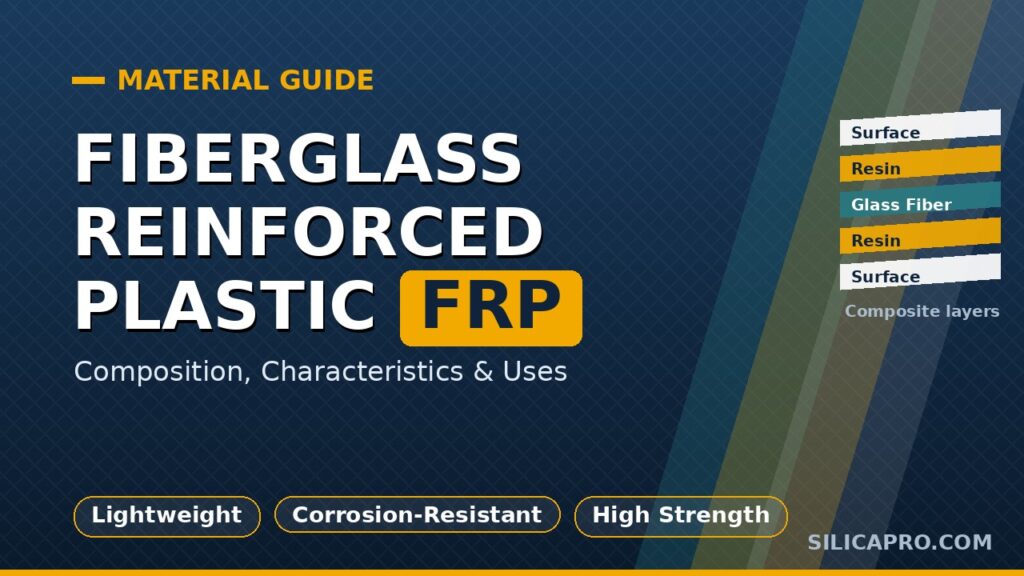
People use fiberglass reinforced plastic as either an alternative or a primary material across a wide range of industries. It represents a genuine shift in how engineers approach material selection. FRP has become known for its excellent characteristics, including versatility and durability, and it is suitable for a broad variety of applications. Despite how widely it is used, many people are still unfamiliar with this material. So what exactly is FRP, and what is its composition and character?
About Fiberglass Reinforced Plastic and Its Composition
In simple terms, FRP is an engineered composite material that combines two or more raw materials into a single product with improved properties. The manufacturing process involves reinforcing a plastic resin with glass fibers. The result is a composite material with many advantages, used in applications such as dampers, tanks, pipes, and structural components.
The two main materials used in making FRP are glass fiber and thermoset resin. FRP combines glass fiber with resin, where the resin provides environmental and chemical resistance once the FRP becomes a finished product. Structural laminates also rely on resin to act as the binder that holds the glass fibers together. To understand how fiber and resin work together in practice, you can also read our article on fiberglass cloth and resin in construction and repair applications.
The choice of resin is not arbitrary. You cannot simply add any type of resin. Instead, the resin must be selected based on the chemical conditions and the environment where the customer will use the product. As a result, the properties of FRP can vary significantly. Some manufacturers give customers the ability to customise the formulation, so the final material depends heavily on where it will be applied.
FRP Composition at a Glance
| Component | Function | Common Options |
|---|---|---|
| Reinforcing fiber | Provides tensile strength and stiffness | E-glass, S-glass, carbon, aramid |
| Resin matrix | Binds fibers, transfers load, protects against environment | Polyester, vinyl ester, epoxy |
| Additives | Adjust properties such as fire retardancy or UV stability | Fillers, pigments, flame retardants |
| Surface veil / gelcoat | Protects the surface and improves corrosion resistance | Resin-rich veil, pigmented gelcoat |
For most FRP applications, E-glass is the most widely used reinforcing fiber due to its balance of strength, cost, and availability. You can learn more about it in our guide to E Glass fiberglass and how to buy from the best supplier.
Lamination Process on Fiberglass Reinforced Plastic (FRP)
In general, manufacturers carry out a finishing process in the form of lamination. The method involves coating the material with layers of resin and fiber so that its durability is improved. A useful comparison is paper finishing, where a plastic film is used to coat the paper so that it does not tear easily and remains protected even when exposed to water. In a similar way, FRP typically uses three types of lamination layers.
- Top surface laminate: Provides product protection so that it resists environmental exposure and temperature variation.
- Corrosion barrier laminate: Makes the product chemically resistant across various temperature levels.
- Structural laminate: The main load-bearing layer that provides mechanical strength and temperature resistance.
As explained earlier, resin selection can vary, and these laminate layers also serve different functions. The most common types of resin used in fiberglass reinforced plastic are polyester, vinyl ester, and epoxy. To achieve the best results, you should also choose the appropriate type of glass fiber based on usage factors and the expected performance. The careful selection of the main materials, the layup technique, and a reliable manufacturer are the keys to producing quality fiberglass reinforced plastic.
FRP Characteristics
Plastic is one of the most widely used materials in daily life, and FRP is an advanced engineered form of plastic composite. This strong yet lightweight material results from combining glass fiber with a plastic resin matrix. So what are the key characteristics of fiberglass reinforced plastic?
The properties of FRP can vary because they depend on the selection and composition of the materials, the production process, and the addition of additives. According to AZoM, the characteristics of fiber-reinforced plastics depend heavily on the mechanical properties of both the matrix and the fiber, the volume of each, and the length and orientation of the fibers. In general, however, the key properties of FRP include the following.
- Resistant to environmental attack: Unlike wood or steel, FRP resists corrosion, mold, insects, moss, and similar forms of degradation.
- High strength-to-weight ratio: FRP can weigh roughly 75 percent less than steel while offering a comparable strength-to-weight performance in many applications.
- Low thermal conductivity: Unlike aluminium and other metals, FRP is a poor conductor of heat, which makes it a good thermal insulator.
- Available with flame-retardant options: With the right resin systems and additives, FRP can be produced in flame-retardant grades, with a wide choice of materials and colors.
- Dimensional stability: FRP maintains its shape and performance across a wide range of temperatures and is not easily affected by temperature fluctuations.
FRP Compared to Conventional Materials
| Property | FRP | Steel | Aluminium |
|---|---|---|---|
| Weight | Very light | Heavy | Light |
| Corrosion resistance | Excellent | Poor (rusts) | Moderate |
| Thermal conductivity | Low (good insulator) | High | Very high |
| Maintenance | Low | High | Moderate |
| Design flexibility | High (moldable) | Limited | Moderate |
The advantages of fiberglass reinforced plastic allow it to replace many conventional materials such as wood, steel, and aluminium in suitable applications. FRP is a high-performance material, and it can be further developed with more advanced production processes in the future.
Today, it is not difficult to find applications for this material. The commercial vehicle, caravan, construction, and medical sectors all use FRP. In application, FRP is also flexible enough to be sawed, drilled, and bonded to other materials without compromising its quality. To understand which fiber type best suits your FRP project, our overview of different types of fiberglass based on material characteristics is a useful reference.
Frequently Asked Questions About Fiberglass Reinforced Plastic
What is the difference between FRP and fiberglass?
The terms are often used interchangeably, but there is a technical distinction. FRP, or fiber-reinforced plastic, is a broad category of composite materials made by reinforcing a polymer resin with fibers. Those fibers can be glass, carbon, aramid, or other materials. Fiberglass, sometimes called GRP (glass reinforced plastic), is specifically the subset of FRP that uses glass fibers as the reinforcement. Since glass fiber composites make up the majority of FRP by volume, people commonly use the terms interchangeably in casual conversation. However, in technical specifications the distinction matters, because the type of fiber significantly affects both the properties and the cost of the final product.
What resin is best for fiberglass reinforced plastic?
The best resin depends on the intended application. Polyester resin is the most common and cost-effective choice for general-purpose FRP. Vinyl ester resin offers improved chemical and moisture resistance, making it suitable for marine, chemical processing, and corrosive environments. Epoxy resin provides the highest strength, best adhesion, and lowest shrinkage, and is typically used for high-performance structural applications such as aerospace and advanced engineering components. The right choice balances performance requirements against budget, so it is important to match the resin to the chemical, thermal, and mechanical conditions the product will face.
Is fiberglass reinforced plastic stronger than steel?
FRP is not stronger than steel in absolute terms, but it has an excellent strength-to-weight ratio. This means that for a given weight, FRP can deliver strength comparable to or, in some directional applications, exceeding that of steel, while weighing significantly less. The key advantage is that FRP achieves useful structural strength at a fraction of the weight, which is why it is widely used where weight reduction matters. It is important to note that FRP behaves differently from steel under load, being strong in tension along the fiber direction but requiring careful engineering for compression and multi-directional stresses.
What are the main applications of FRP?
Fiberglass reinforced plastic is used across a remarkably wide range of industries. Common applications include storage tanks and pressure vessels, piping systems, structural gratings and walkways, commercial vehicle and caravan body panels, construction components such as cladding and rebar, marine structures including boat hulls, and equipment in the chemical and medical sectors. Its combination of light weight, corrosion resistance, and design flexibility makes it suitable for almost any application where traditional metals would corrode, add excessive weight, or be difficult to mold into complex shapes.
How long does fiberglass reinforced plastic last?
Well-manufactured FRP structures can have a very long service life, often exceeding several decades even in demanding outdoor and marine environments. The main degradation mechanisms are surface-level UV exposure, which causes cosmetic chalking but does not significantly reduce structural strength, and long-term moisture or chemical exposure. With proper resin selection, surface protection such as a gelcoat or UV-resistant topcoat, and appropriate maintenance, FRP products routinely outlast comparable steel or wood components, particularly in corrosive conditions where metals would fail much sooner.
Where can I source quality fiberglass for FRP production?
Quality FRP starts with quality reinforcing fiber. Silicapro, operated by Bright Sky New Material Co Ltd. in Zhejiang, China, manufactures and exports a wide range of glass fiber products suitable for FRP production, including fiberglass cloth, chopped strands, and high-silica materials. With over ten years of manufacturing experience and export markets across North America, Europe, the Middle East, and Asia, Silicapro can supply the appropriate fiber type and form for your specific FRP application. Requesting product samples and technical specifications before placing a bulk order is recommended to ensure the material matches your resin system and performance requirements.
Last reviewed and updated on April 26, 2026, by Lucy Huang, High-Silica Material Specialist at Bright Sky New Material Co Ltd. (SilicaPro). This article is reviewed periodically to ensure accuracy and alignment with current industry standards.