
SilicaPro
Para-Aramid Yarn Fire-Proof
Flame Retardant Para-Aramid Yarn
A premium 100 percent para-aramid continuous filament yarn, inherently flame resistant by molecular structure rather than by chemical treatment. It does not melt and it does not drip, which is the property that separates it from every synthetic fibre it competes against.
Tenacity at break of 21 cN per dtex and an elastic modulus of 88 GPa put it among the strongest and stiffest textile fibres available, which is why it appears as the strength member inside fibre optic cables as well as in protective clothing.
Supplied at 1.5 denier fineness in 57,000 metre lengths, in natural yellow, black or custom colours. Used for weaving, packing, optical cable reinforcement, protective textiles, insulation and industrial reinforcement fabrics.

It Chars. It Does Not Melt.
Four words on a specification sheet that carry more weight than every other line: does not melt or drip. For anything worn on a body near fire, this is the difference between a garment that protects and a garment that makes the injury worse.
Conventional synthetic fibres are thermoplastic. Polyester, nylon and polypropylene soften as temperature rises, then flow. In a fire, a garment made from them does not simply burn away. It melts, adheres to skin, and continues transferring heat after the flame has gone. Emergency clinicians treat those injuries differently from ordinary burns because the molten polymer has to be dealt with before the burn beneath it can be.
Para-aramid does not do this. The polymer has no melting point in the conventional sense. Under sufficient heat it chars and carbonises, forming a rigid carbonaceous layer, and that layer stays in place rather than flowing. The garment remains a garment.
The practical consequence is that the fabric keeps working during the event rather than becoming part of the problem. A charred aramid layer still separates the wearer from the heat. A melted synthetic layer is a heat source held against the skin.
This is why para-aramid became the standard fibre for firefighter turnout gear, industrial protective clothing and military applications, and why substituting a cheaper synthetic into a protective garment is a decision with consequences that only appear at the worst possible moment.
The same behaviour matters in industrial applications that have nothing to do with clothing. A reinforcement yarn that melts inside a composite creates a void where the reinforcement used to be. A cable strength member that softens under heat allows the cable to stretch. In both cases the failure is silent until it is total.
Inherent, Not Treated
Flame resistant textiles fall into two categories, and the difference is not visible in a sample or in a first year of service. It becomes visible around the twentieth wash.
Chemically Treated FR
An ordinary fibre such as cotton or polyester with a flame retardant chemical applied to it. The treatment slows ignition and flame spread while it remains present on the fibre.
Treatments wear. Washing, abrasion and time all reduce the loading, and a garment that passed certification when new may not pass after a year of laundering. This is why treated FR workwear carries a wash count limit.
Performance declines with useInherently Flame Resistant
The flame resistance is a property of the polymer molecule itself. Nothing was added, so nothing can be removed. Our para-aramid yarn is self extinguishing in air and stable in high heat because of what it is made of.
The fibre performs identically on its first day and after hundreds of wash cycles, because the property is in the chemistry rather than on the surface.
Performance does not declineInherent fibre costs more per kilogram, and treated FR is genuinely adequate for many applications where garments are replaced regularly and the fire risk is low. Where it becomes a false economy is in high risk work, long service life, or any situation where nobody is tracking wash counts on individual garments.
The parallel with our fireproof cloth is exact, incidentally. That product is non-combustible by composition rather than flame retardant by treatment, for the same reason and with the same consequence. Different material, same principle.
Reading the Strength Figures
Two numbers define the mechanical performance, and they describe genuinely different things. Buyers who look only at the first one specify the wrong yarn for cable reinforcement.
Tenacity is strength relative to weight rather than to cross section, which is how textile fibres are compared. It measures how much force the yarn carries before it breaks, divided by its linear density.
This figure is what puts para-aramid among the strongest textile fibres in commercial use, and it is why the fibre is specified where a metal cable of equivalent strength would be too heavy to be practical.
Modulus is stiffness rather than strength. It measures how much the fibre resists being stretched under load, and a high modulus means the yarn holds its length rather than extending.
For optical cable reinforcement this is the decisive property. A cable that stretches puts strain on the glass fibre inside it, and strained glass fibre degrades the signal before it breaks anything visible.
High strength and high modulus are not the same requirement and do not always travel together. A yarn can be strong but stretchy, which suits applications absorbing shock loads. A yarn can be stiff but brittle, which suits precision reinforcement.
Para-aramid delivers both at once, and that combination is unusual enough to be the reason the fibre is chosen over cheaper alternatives that match it on one measure but not the other. Tell us which property drives your application and we will confirm the specification suits it.
Key Features
Four characteristics define the yarn in service, and each drives a different family of applications.
- Inherent flame resistance. Self extinguishing in air and stable in high heat conditions, delivered by the polymer structure rather than by chemical treatment. Nothing washes out and nothing wears off.
- High strength and modulus. Tenacity at break of 21 cN per dtex with an elastic modulus of 88 GPa. Strong enough for safety gear, stiff enough for precision reinforcement, and both in the same fibre.
- Thermal stability. Withstands elevated temperatures during industrial use without melting, dripping or losing its structural function.
- Chemical and heat resistance. Reliable performance in harsh environments where thermal exposure arrives alongside chemical attack.
Worth adding a fifth characteristic that appears nowhere on a specification sheet: the fibre is light. Para-aramid achieves its strength at a fraction of the weight of steel or glass equivalents, and in protective clothing and cable applications alike, weight is frequently the constraint that decides what is practical rather than what is possible.
Technical Specifications
Standard supply specification. Lengths, colours and specifications are all produced to order, so ask rather than assume something is unavailable.
| Specification | Details |
|---|---|
| Product name | Flame Retardant Para-Aramid Yarn |
| Product type | Aramid yarn |
| Material | 100 percent para-aramid |
| Chemical composition | Para-aramid |
| Fibre form | Filament yarn |
| Features | Flame retardant, heat resistant, thermal insulation |
| Yarn length | 57,000 metres |
| Fineness | 1.5 denier |
| Tenacity at break | 21 cN/dtex |
| Elastic modulus | 88 GPa |
| Colour | Natural yellow standard. Black and custom colours available |
| Application | Weaving, packing, optical cable reinforcement |
| End use | Protective textiles, insulation materials, industrial reinforcement |
| Packaging | Film bag and carton box |
| OEM and wholesale | Available, including custom lengths, colours and specifications |
Colour Options
Natural yellow is the undyed colour of the fibre itself, which is why it costs least and why so much aramid product in the market is that colour. Black and custom colours are produced to order.
If colour matters to your product, specify it at order stage. Colour is introduced during production rather than applied afterwards, so it is not something that can be adjusted once the yarn is made.
Applications
Five application families, spanning safety textiles through to telecommunications infrastructure.
Protective and Flame Resistant Textiles
Firefighter gear, industrial protective clothing, welding garments and safety equipment where the wearer may be exposed to flame or radiant heat.
The non-melting behaviour is the reason the fibre is specified here rather than a treated alternative, and it is a decision that only proves itself during an incident.
Optical Cable Reinforcement
Strength members inside fibre optic cable, carrying the tensile load during installation pulling and preventing the cable stretching in service.
The 88 GPa modulus is what matters here rather than raw strength. Glass fibre inside a stretched cable suffers signal degradation long before anything physically breaks, so the reinforcement must resist extension rather than merely resist snapping.
Industrial Reinforcement Fabrics
Woven reinforcement for composites, belting, hoses and technical structures needing high strength at low weight.
Because the fibre does not melt, a reinforced component retains its reinforcement during a thermal event rather than developing voids where the yarn used to be.
High Temperature Insulation
Insulation textiles where flame resistance, thermal stability and mechanical strength are all required from a single material.
For applications above the organic fibre range, our inorganic high silica products take over, and we will say so rather than push aramid beyond where it belongs.
Weaving and Technical Textiles
Continuous filament supply for weavers, braiders and technical textile manufacturers producing their own fabric and tape.
The 57,000 metre package length is designed for continuous production runs, where frequent creel changes cost more in stopped machine time than the yarn does.
Para-Aramid or High Silica
This is the only organic fibre in our range. Everything else we make is inorganic silica or glass, and the two families fail in completely different ways. Choosing between them on temperature alone produces the wrong answer surprisingly often.
| Property | Para-Aramid Yarn | High Silica Yarn and Thread |
|---|---|---|
| Chemistry | Organic polymer | Inorganic silica glass |
| Temperature capability | Moderate. Chars rather than melts | Far higher, continuous service at 900 degrees Celsius |
| Tensile strength | Very high for its weight | Moderate |
| Cut resistance | Excellent | Limited |
| Flexibility and handling | Textile-like, comfortable against skin | Stiffer, less suited to worn garments |
| Weight | Light | Heavier |
| Best suited to | Worn protection, cut resistance, structural reinforcement | Sustained high temperature, furnace and welding work |
The simple version is that para-aramid is chosen for strength, weight and wearability, while high silica is chosen for temperature. If a person is wearing it or a structure depends on its tensile strength, aramid is usually the answer. If it is sitting against a furnace, silica is.
Para-aramid is generally sensitive to prolonged UV exposure. This is a characteristic of the polymer family rather than of any particular supplier's product, and it matters in applications with sustained direct sunlight.
In most uses this is a non issue, because the yarn sits inside a cable, inside a composite, or under an outer fabric layer. Where the fibre would be directly exposed outdoors for years, discuss it with us at inquiry stage so it can be designed around rather than discovered later.
Para-Aramid Yarn From Our Supply
Material as supplied, in the natural yellow that is the undyed colour of the fibre itself.
-
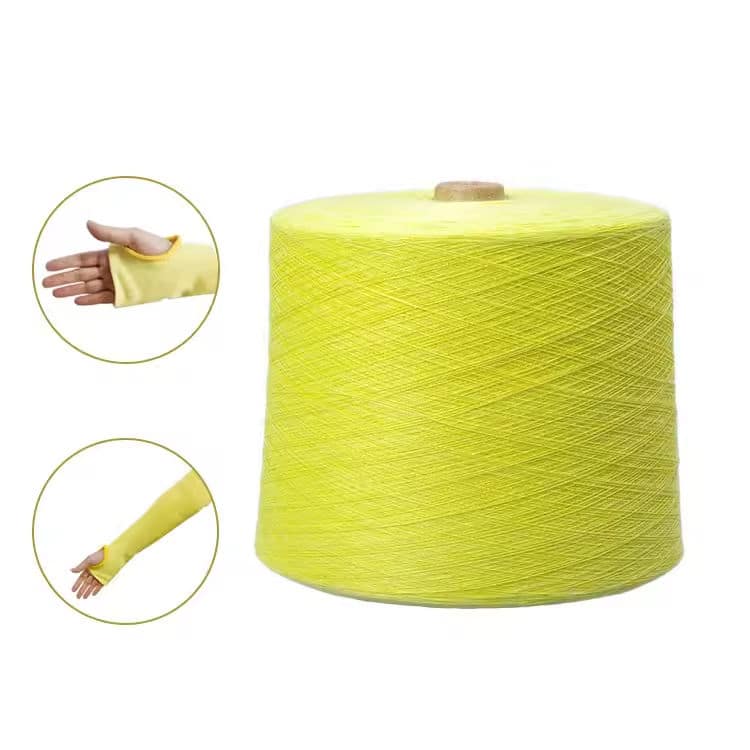
Natural yellow filamentUndyed fibre colour, supplied in 57,000 metre lengths for continuous production. -
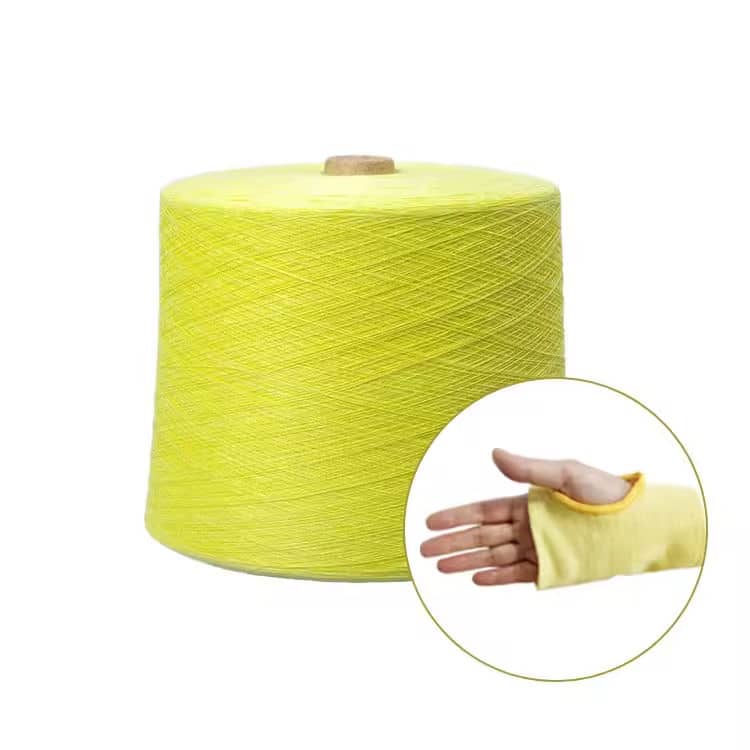
Continuous filamentFilament rather than staple, which is what delivers the tensile performance. -
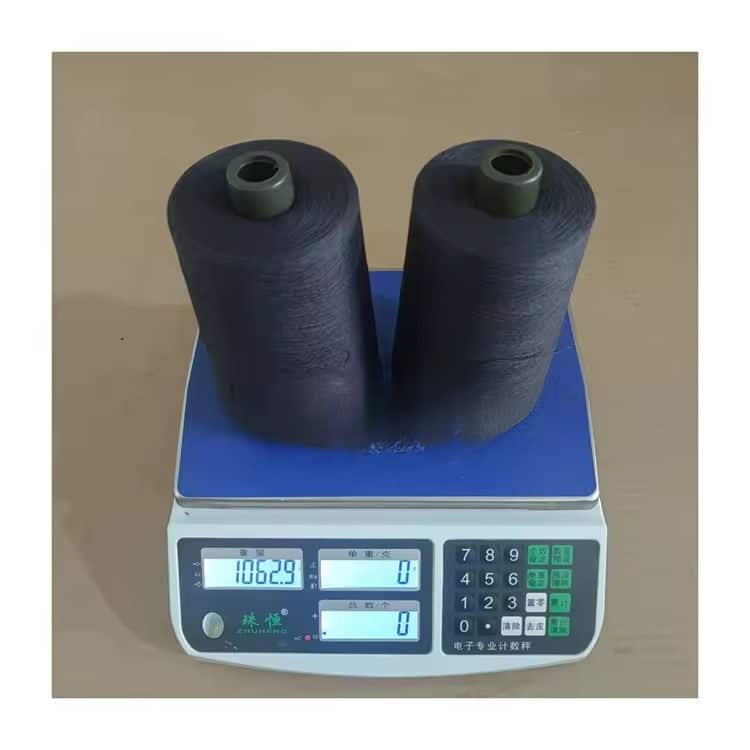
Wholesale supplyPacked in film bag and carton box for export shipment.


How to Specify Para-Aramid Yarn
Five answers let us confirm the specification rather than shipping standard and hoping it suits.
- What are you making with it? Woven fabric, braided cord, cable reinforcement or something else. The process determines whether filament yarn is even the right form, since some applications need staple fibre instead.
- Is strength or stiffness the driving property? These are different requirements. If the yarn must not stretch, as in cable reinforcement, modulus governs. If it must not break under load, tenacity governs. Say which matters.
- Does it face direct sunlight in service? Para-aramid is generally UV sensitive. If the fibre sits inside a cable or under an outer layer this is irrelevant, but sustained direct exposure needs to be designed around.
- What certification does your end product need? Protective clothing frequently has to meet a specific standard in the destination market, and the fibre specification forms part of that documentation.
- What colour and package length do you need? Natural yellow is standard and lowest cost. Colour is introduced during production rather than applied afterwards, so it has to be specified at order stage.
If you are considering para-aramid against a cheaper treated FR alternative, tell us the service life and the wash frequency of the end product. That comparison usually resolves itself once those two numbers are on the table.
Wholesale and OEM Supply
SilicaPro supplies para-aramid yarn in wholesale volumes and under OEM arrangements for weavers, braiders, cable manufacturers, protective clothing producers and technical textile companies worldwide.
Custom lengths, colours and specifications are available. The 57,000 metre standard package suits continuous production, where frequent creel changes cost more in stopped machine time than the yarn itself does, but shorter packages are produced where the run length does not justify it.
One point worth raising if you are producing protective textiles. We also supply para-aramid fabric and short staple fibre alongside this yarn, and a manufacturer building a full product line frequently needs more than one form. Sourcing them from one plant keeps the fibre specification consistent across the range rather than mixing material from several origins.
Around 70 to 80 percent of our total output is exported, so the documentation, packing and inspection routines that international orders require are routine here rather than exceptional.
Para-Aramid Yarn Questions
The questions manufacturers, weavers and procurement teams ask us most often.
What does it mean that the yarn does not melt or drip?
Thermoplastic fibres such as polyester and nylon soften and flow when heated. In a fire, a garment made from them melts and adheres to skin, continuing to transfer heat after the flame is gone.
Para-aramid has no melting point in that sense. Under sufficient heat it chars and carbonises, forming a rigid layer that stays in place. The fabric remains a barrier rather than becoming a heat source held against the wearer. For protective clothing this distinction is the entire reason the fibre is specified.
How is this different from chemically treated flame retardant fabric?
Treated FR is an ordinary fibre with a flame retardant chemical applied. The treatment works while it remains present, and it reduces with washing, abrasion and time. Treated garments therefore carry a wash count limit.
Our yarn is inherently flame resistant. The property is in the polymer molecule, so nothing was added and nothing can wear off. It performs identically on its first day and after hundreds of wash cycles. For high risk work or long service life, that difference is the whole argument.
What is the difference between tenacity and modulus?
Tenacity is strength, measuring how much force the yarn carries before breaking, expressed relative to its linear density. Ours is 21 cN per dtex. Modulus is stiffness, measuring how much the fibre resists being stretched. Ours is 88 GPa.
They are different requirements. A yarn can be strong but stretchy, or stiff but brittle. Para-aramid delivers both, which is unusual and is often the reason it is chosen over cheaper fibres that match it on one measure alone.
Why is para-aramid used in fibre optic cables?
Because of the modulus rather than the strength. Fibre optic cable gets pulled hard during installation and must not stretch, since strain on the glass fibre inside degrades the signal long before anything physically breaks.
Aramid yarn takes that tensile load while adding very little weight and no electrical conductivity, which matters for cables running near power infrastructure. The combination of high modulus, low weight and non conductivity is why it became the standard strength member.
Should I use para-aramid or your high silica products?
Choose on the function rather than on temperature alone. Para-aramid is light, strong, cut resistant and comfortable enough to wear. High silica is far more heat resistant but heavier, stiffer and not suited to worn garments.
If a person is wearing it or a structure depends on its tensile strength, aramid is usually right. If it sits against a furnace or takes molten metal spatter, high silica is. Where a genuinely high temperature requirement arrives, we will say so rather than push aramid beyond where an organic fibre belongs.
Is the yarn affected by sunlight?
Para-aramid is generally sensitive to prolonged UV exposure. This is a characteristic of the polymer family rather than of any one supplier's product.
In most applications it does not matter, because the yarn sits inside a cable, inside a composite, or beneath an outer fabric layer. Where the fibre would be directly exposed outdoors for years, raise it at inquiry stage so it can be designed around rather than discovered in service.
Why is the standard colour yellow?
Natural yellow is the undyed colour of the fibre itself, which is why so much aramid product in the market is that colour and why it is the lowest cost option.
Black and custom colours are available. Colour is introduced during production rather than applied afterwards, so it must be specified at order stage and carries its own minimum quantity.
Do you supply para-aramid in other forms?
Yes. We also supply para-aramid fabric for protective clothing and reinforcement, and para-aramid short staple fibre for friction materials, gaskets and dispersion into compounds.
If you are building a product line that needs more than one form, sourcing them from one plant keeps the fibre specification consistent across the range rather than mixing material from several origins.
Can I get a sample before ordering?
Yes. For a yarn destined for weaving or braiding we would rather you ran it on your own equipment than took the specification on trust, since machine behaviour varies between workshops.
Tell us the process and the machine when you request a sample so we send something matched to it rather than a generic length.
What certification documentation can you supply?
Protective clothing frequently has to meet a specific standard in the destination market, and the fibre specification forms part of that documentation package.
Tell us at quotation stage which standard your end product is being certified to and what documentation your approval process requires, and we will confirm what we can provide with the shipment rather than after it.
What is your minimum order quantity?
Standard specification in natural yellow carries a lower minimum because the material already exists in that form. Custom colours and non standard specifications need their own production run, which raises both the minimum and the lead time.
Tell us the specification and your rough volume and we will confirm the exact figure with your quotation.
What are your payment terms and shipping options?
Payment is normally by T/T, structured as a deposit with the balance settled before shipment. We confirm the exact split with your quotation.
EXW, FOB, CIF and DAP terms are all available, so you can pick whichever fits how your freight is already arranged. If you have a nominated forwarder we will work with them directly.
Related Products
Other para-aramid forms, and the inorganic materials that take over where temperature exceeds the organic fibre range.
Tell Us What You Are Making and We Will Confirm the Specification
Send the process, whether strength or stiffness drives the application, the colour you need and your volume. We reply with a specification, pricing and a lead time we can hold to.
Request a QuotePhone
+8613758326701
Bright Sky New Material Co Ltd.
Room 1101-11, 11/F,Youbang Building. Jiaxing Headquarters Business Garden, Nanhu District, Jiaxing, Zhejiang, 314000 - China
sales@silicapro.com
lucyhhyy@gmail.com
© 2021 SILICAPRO.COM
All Rights Reserved