
SilicaPro
High Silica Fiberglass Cloth
High Silica Fiberglass Cloth, More Than 96 Percent SiO2
High silica fiberglass cloth is an inorganic high temperature resistant fabric woven from glass fibre that has been chemically leached until more than 96 percent of what remains is silicon dioxide. That single figure is what separates it from every other glass fabric on the market, and it is the reason the cloth keeps working at temperatures where ordinary fiberglass has already softened and failed.
We produce it at our own plant in Jiaxing, Zhejiang, from acid leaching through weaving and heat treatment to surface coating. Standard cloth runs from 0.6 mm to 1.35 mm thick, in plain and satin weave, supplied uncoated or with silicone, graphite, PTFE or vermiculite treatment depending on what the fabric has to survive.
It is used most heavily in welding protection, furnace and kiln insulation, expansion joints, removable insulation covers and heat shields, across power generation, petrochemical, shipbuilding, aerospace and metal processing industries.

Why High Silica and Not Ordinary Fiberglass
This is the question that brings most buyers to this page, and it deserves a direct answer rather than a sales one. Ordinary E-glass cloth is cheaper, widely available and perfectly adequate for a great many jobs. If your application sits comfortably below 500 degrees Celsius, buy E-glass and spend the difference elsewhere.
The problem is what happens above that. E-glass contains a mixture of oxides, including calcium, aluminium, boron and magnesium alongside silica. Those additional oxides lower the melting point, which is useful during manufacture and unhelpful in service. As temperature climbs toward 550 degrees, an E-glass fabric begins to lose tensile strength, then softens, then deforms. It does not burst into flame, which is why it is often described as fire resistant, but it stops doing its structural job well before it stops existing.
High silica fabric is made by taking glass fibre and removing almost everything except the silica. What is left behind is an amorphous silica structure with a softening point around 1700 degrees Celsius, giving continuous service capability up to 1000 degrees. The fabric stays flexible, keeps its weave and continues to insulate at temperatures that would have destroyed the E-glass version hours earlier.
| Property | Ordinary E-Glass Cloth | High Silica Fiberglass Cloth |
|---|---|---|
| SiO2 content | Roughly 52 to 56 percent | More than 96 percent |
| Continuous working temperature | Around 500 to 550 degrees Celsius | Up to 1000 degrees Celsius |
| Softening point | Around 840 degrees Celsius | Around 1700 degrees Celsius |
| Behaviour at high temperature | Loses strength, softens and deforms | Retains weave structure and insulating function |
| Chemical resistance | Moderate, vulnerable to acids | Strong resistance to most acids and corrosive media |
| Relative cost | Low | Considerably higher |
| Best suited to | General insulation, moderate heat, cost driven work | Sustained high temperature, molten metal exposure, critical protection |
The honest summary is that high silica is not a better version of fiberglass in every respect. It costs more, and for low temperature work that extra cost buys nothing you can use. What it buys is temperature headroom, and headroom only matters when you need it. If you are unsure which side of the line your application falls on, send us the operating conditions and we will tell you plainly.
Main Characteristics
Seven properties define how this fabric behaves in service, and each of them determines a different kind of application.
- SiO2 content above 96 percent. The figure everything else follows from. It is also the figure most worth verifying independently, because it is the one an unscrupulous supplier is most tempted to round upward.
- Softening point around 1700 degrees Celsius, continuous use up to 1000 degrees. Two separate numbers that are often confused. The continuous rating is where the fabric works reliably over long service. The softening point is where the material itself begins to lose structure.
- Low thermal conductivity. The fabric resists heat transfer rather than merely surviving heat, which is what makes it useful as insulation rather than only as a barrier.
- Outstanding chemical and corrosion resistance. Silica is stable against most acids and corrosive media, which matters in petrochemical and chemical processing environments where thermal exposure comes with chemical exposure.
- High electrical insulation performance. Useful in thermocouple insulation, cable protection and applications where heat and electrical isolation are needed from the same material.
- Non-asbestos, non-toxic and eco-friendly. An increasingly decisive point in markets that have restricted or banned older refractory materials for personnel protection use.
- Flexible and easy to process. It can be cut, sewn and coated using conventional textile methods, which is what allows it to be turned into blankets, covers, sleeves and jackets rather than only supplied as flat sheet.
That last characteristic is worth dwelling on, because it is the practical difference between high silica fabric and several materials that beat it on pure temperature resistance. A material that reaches 1400 degrees but shatters when folded is of no use in a removable insulation jacket that has to be fitted around a valve, removed for maintenance and refitted twenty times. High silica cloth handles like a textile, and that is often why it gets specified over technically hotter alternatives.
Technical Specifications
Typical values for our standard high silica fiberglass cloth. Non standard widths, weights, weaves and surface treatments are produced to order, so ask rather than assume something is unavailable.
| Property | Typical Value |
|---|---|
| Material | Inorganic amorphous silica glass fibre |
| SiO2 content | More than 96 percent |
| Continuous working temperature | Up to 1000 degrees Celsius |
| Softening point | Around 1700 degrees Celsius |
| Thickness | 0.6 mm to 1.35 mm standard |
| Weave | Plain and satin. Other constructions produced to order |
| Surface treatment | Uncoated, silicone, graphite, PTFE, vermiculite, aluminium foil |
| Thermal conductivity | Low, suitable for insulation as well as barrier use |
| Chemical resistance | Resistant to most acids and corrosive media |
| Electrical insulation | High |
| Composition safety | Non-asbestos, non-toxic, eco-friendly |
| Processing | Cuttable, sewable and coatable using conventional textile methods |
| Supply form | Rolls, cut pieces, or converted into finished products in house |
| OEM and private label | Available, including custom packaging and carton marking |
One note on thickness. Buyers frequently specify a heavier cloth than the job requires, on the reasonable assumption that thicker is safer. In practice, thickness mostly buys mechanical durability and a small amount of additional thermal mass, while temperature resistance comes from the fibre chemistry rather than from how much of it there is. A 0.8 mm cloth and a 1.35 mm cloth of the same grade withstand the same temperature. The thicker one simply survives more handling. If your application is thermally demanding but mechanically gentle, the lighter option may serve you better and cost less.
Choosing a Surface Treatment
Coating choice is where most specification errors happen, because buyers select on temperature when they should be selecting on hazard. Here is what each treatment actually does, and when it is the right answer.
Uncoated
The base cloth with nothing added. Highest temperature capability of any option here, because no coating means nothing to break down before the silica does.
The trade off is handling. Bare high silica cloth is more prone to fraying at cut edges and offers no resistance to liquid or molten splash.
Best for pure thermal insulationSilicone Coated
The most widely specified treatment. Silicone adds abrasion resistance, water repellency and considerably easier handling, and it seals the surface so the fabric sheds rather than absorbs.
Note that the coating has a lower temperature rating than the cloth beneath it, so a silicone treated product is limited by the silicone, not by the silica.
Best for removable jackets and expansion jointsGraphite Coated
Graphite gives a low friction, self lubricating surface with good release properties. Where fabric moves repeatedly against metal, an uncoated cloth abrades and a graphite treated one slides.
It also improves thermal conduction across the surface, which is occasionally desirable and occasionally not, so it is worth confirming which you need.
Best where the fabric moves against metalPTFE Coated
PTFE delivers excellent chemical resistance and a very low friction, non stick surface. Where thermal exposure comes alongside aggressive chemicals, this is usually the right specification.
It is the most expensive of the common treatments, which is why it should be chosen for a reason rather than as a default premium option.
Best for combined heat and chemical exposureVermiculite Coated
The treatment for molten metal. Vermiculite forms a surface that resists splash and spatter instead of allowing it to burn through, which is why welding and foundry products use it almost universally.
Recognisable by its tan finish and noticeably stiffer handle compared with uncoated or silicone treated cloth.
Best for welding and foundry workAluminium Foil Faced
Works on a different principle from the others. Rather than resisting contact heat, the reflective surface turns radiant heat away before it reaches the fabric.
Highly effective against radiant sources and largely irrelevant against conductive contact, so the distinction matters when specifying.
Best against radiant heat sourcesIf you are uncertain, describe the hazard rather than naming a coating. Tell us whether the heat arrives by contact, radiation or splash, whether there is abrasion, whether chemicals are present and whether the fabric is fitted once or handled repeatedly. Those five answers determine the treatment more reliably than any temperature figure on its own.
How the Cloth Is Made
High silica fabric is not woven from a special fibre that arrives ready made. It is created by chemically stripping ordinary glass fibre of almost everything except silica, and the quality of that stripping is what determines whether the finished cloth meets its rating.
-
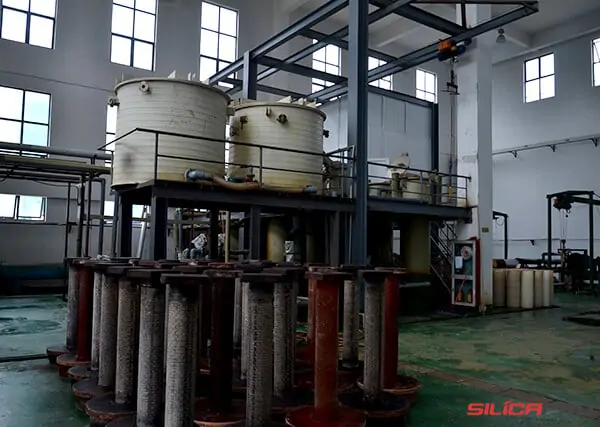
1. Acid leachingYarn is treated until the calcium, aluminium, boron and magnesium oxides are stripped out, leaving amorphous silica above 96 percent. -
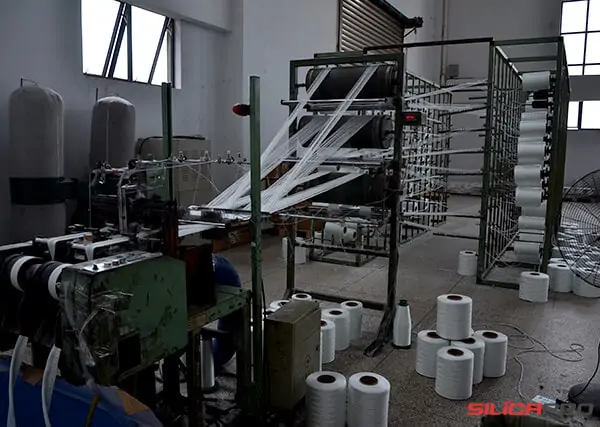
2. WarpingTreated yarn is beamed at controlled tension. Uneven tension at this stage becomes width variation in the finished roll. -
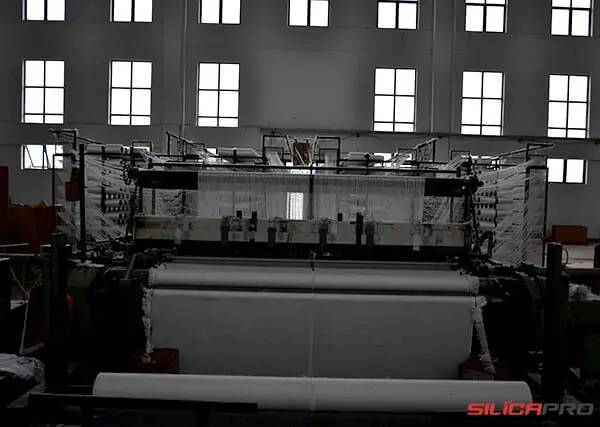
3. WeavingPlain and satin weave on wide looms. Weave style affects drape and handling as much as it affects strength. -
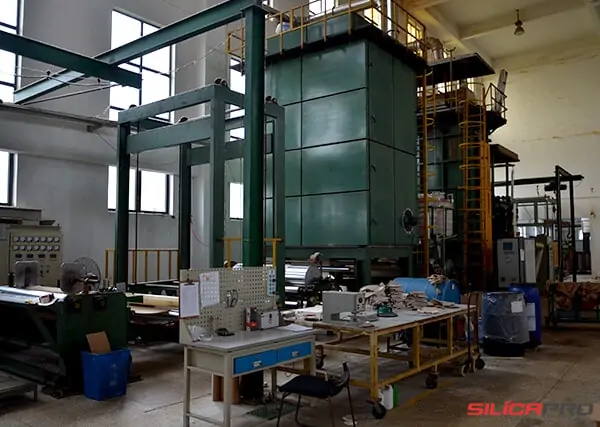
4. Heat treatmentResidual sizing is burned off and the cloth stabilised, so it does not shrink or smoke the first time a customer heats it. -
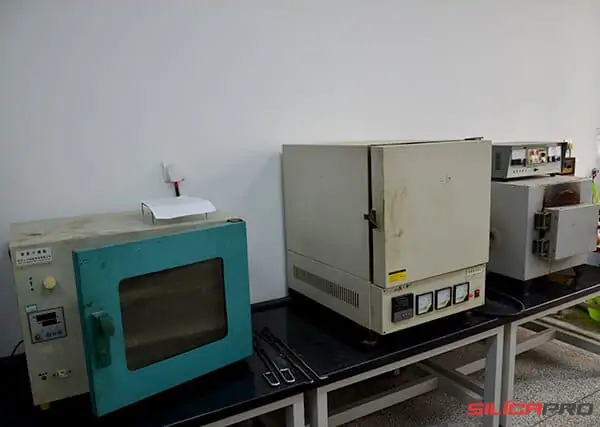
5. Loss on ignitionA sample is fired and the weight loss measured. This is the number that proves whether the leaching actually worked. -
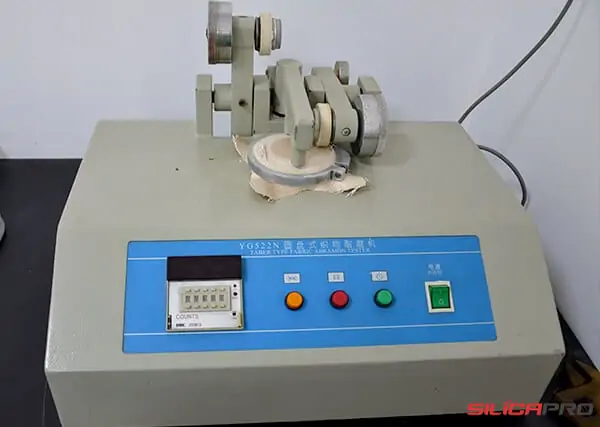
6. Abrasion testingCycles to failure on coated goods, where the coating gives out long before the fibre underneath does.
The stage worth understanding as a buyer is the fourth one. Heat treatment removes the sizing agents used during weaving, and a manufacturer who skips or shortens it delivers cloth that smokes, smells and shrinks the first time it is brought up to temperature. That is not a defect you can see in a sample photograph, and it is one of several reasons why buying from the plant that wove the fabric is a materially different proposition from buying through an intermediary.
Applications
High silica fiberglass cloth is used wherever ordinary glass fabric runs out of temperature headroom. These are the applications we supply most often.
Welding and Fire Blankets
The largest single use. Vermiculite treated cloth resists molten spatter while the base fabric handles the sustained radiant heat around a welding position. Also converted into fire blankets for industrial and vehicle use.
Expansion Joints
Ducting and pipework that expands and contracts through thermal cycling needs a flexible sealing element that survives the temperature. High silica cloth flexes without losing its rating.
Removable Insulation Covers
Valves, flanges and turbine components that need regular access cannot be permanently lagged. Sewn covers in coated high silica fabric are fitted, removed and refitted without degrading.
Furnace, Kiln and Turbine Insulation
Sustained high temperature environments where the material is expected to remain in place and functional for long periods rather than survive an incident.
Aerospace and Automotive Heat Shields
Exhaust shielding, muffler insulation and thermal barriers where weight matters and space is limited. The fabric can be formed around complex shapes that rigid insulation cannot follow.
Thermal Protection and Ablation Resistant Components
Composite applications where the fabric acts as a reinforcement that also carries the thermal load, including ablative structures designed to erode in a controlled way.
Fire Resistant Doors and Curtains
Passive fire protection in buildings, industrial plants and marine environments, where the material must hold back flame and radiant heat for a defined period.
Thermocouple and Cable Insulation
Where the combination of high electrical insulation and high temperature resistance is needed from a single material in a confined space.
Protective Clothing
Firefighter and foundry worker protection, where the non-asbestos composition and the flexibility of the fabric both matter as much as the temperature rating.
The Material Under Actual Flame
A datasheet states a temperature. These clips were filmed on our own material and show what that rating looks like in practice.
Sustained Flame Test
Behaviour over time rather than at first contact.
Direct Flame Test
Torch applied straight to the fabric surface.
Heat Resistance Test
Thermal barrier performance under load.
Flame Retardant Test
How the fabric behaves once flame is removed.
-
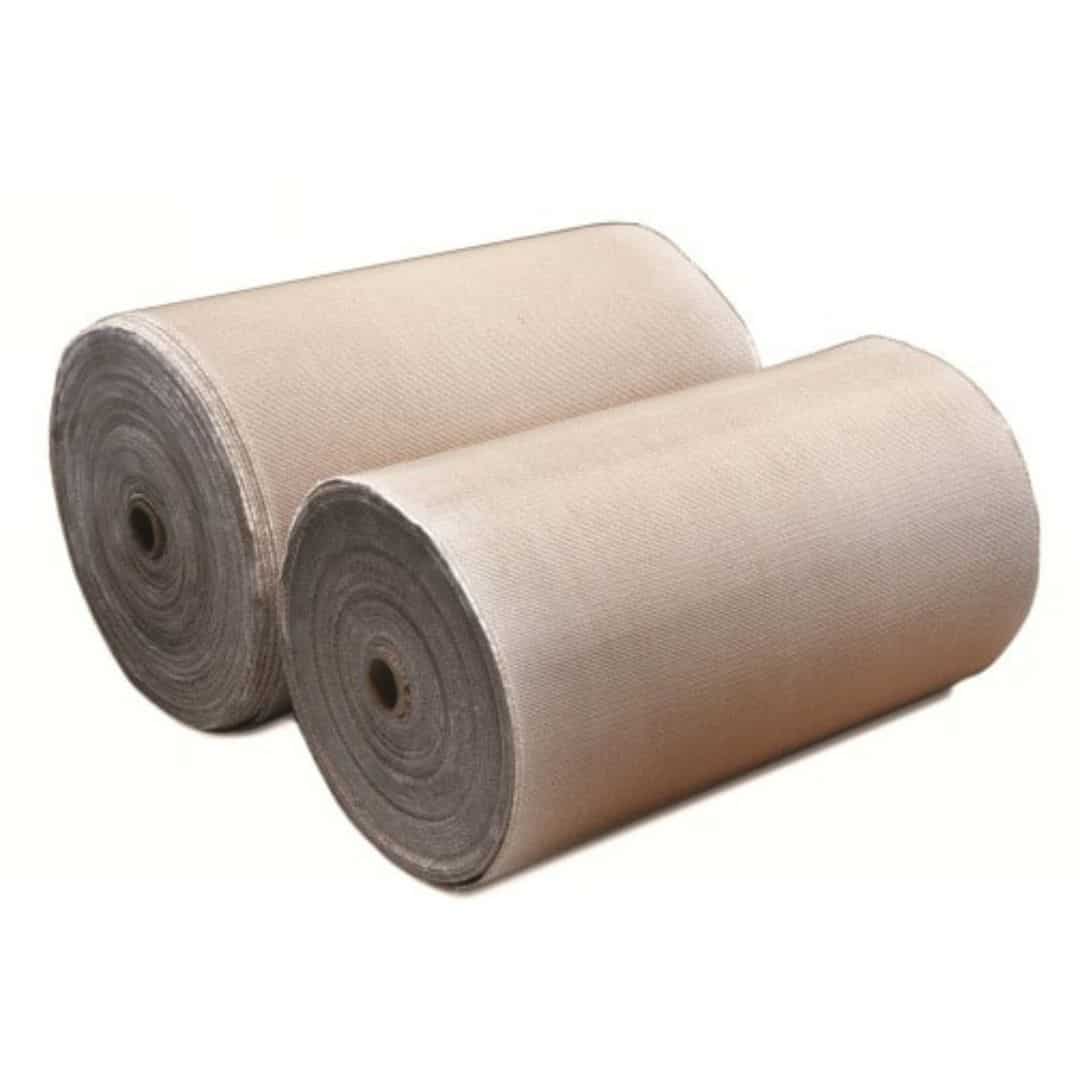
Fire resistant clothBase fabric supplied for flame retardant and fire protection conversion. -
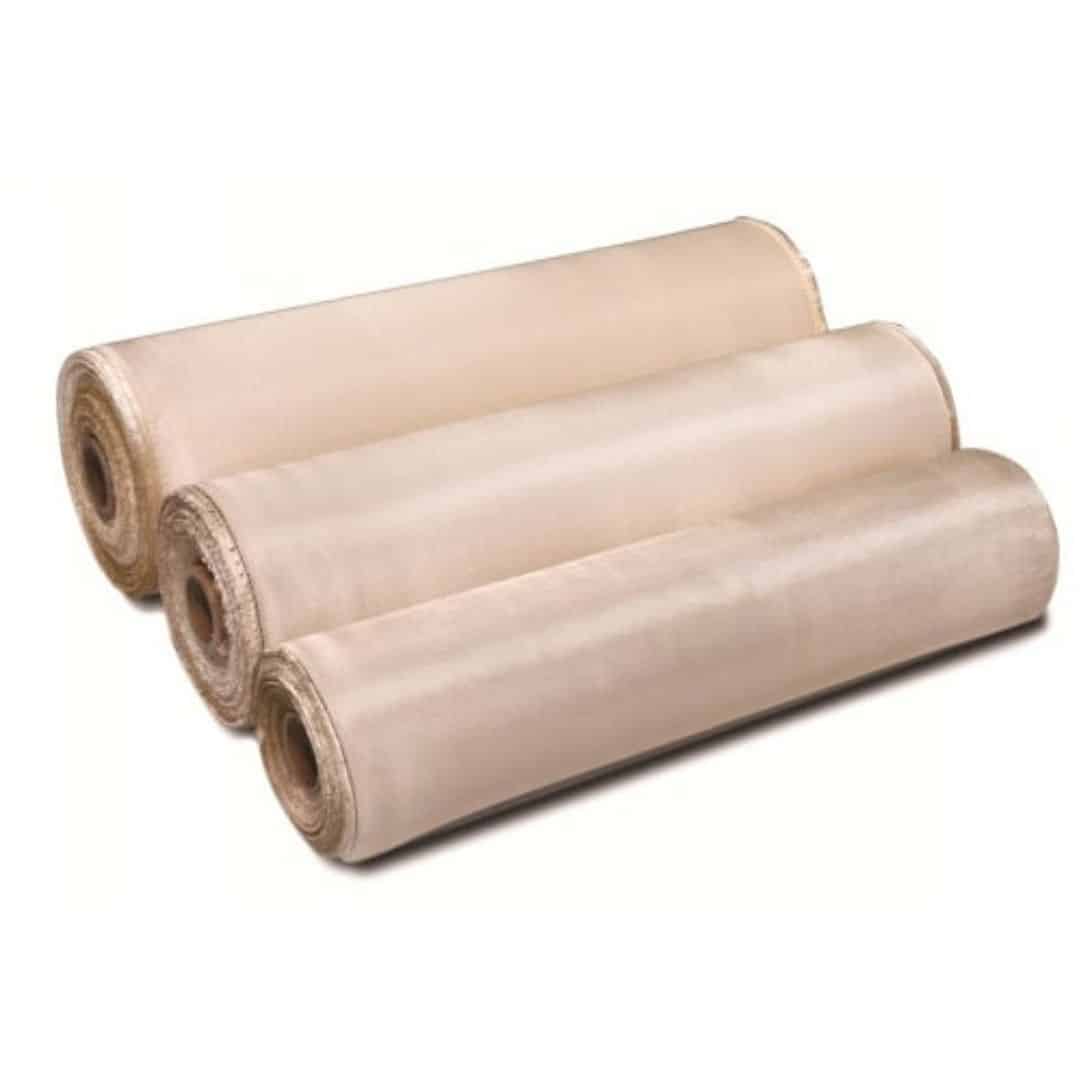
Bulk roll supplyStandard specifications held in stock and shipped without waiting for a production slot. -

OEM supplyPrivate label and custom specification programmes for distributors and converters.


How to Verify What You Are Buying
High silica fabric is one of the easier products in this industry to misrepresent, because the property that justifies the price is invisible. A 90 percent silica cloth and a 96 percent silica cloth look identical, feel similar and cost very differently to produce. Here is how to check, whoever you buy from.
- Ask for the loss on ignition figure. This is the single most revealing test. A sample is heated until everything volatile has burned away and the weight loss is measured. Any manufacturer running the process properly has this number for their material and will hand it over without hesitation.
- Ask for a chemical analysis. Silica content should be stated as a specific figure, not as a range or an approximation. A supplier who describes their cloth only as high silica without a number is worth pressing further.
- Request a physical sample and test it independently. Send it to your own laboratory or a third party. Any manufacturer confident in the material will encourage this rather than discourage it, because independent confirmation is the strongest sales argument they have.
- Ask who wove it. A manufacturer can name the process, the equipment and the shift. A trading company will describe the product but grow vague about the production, because they are relaying information rather than reporting it.
- Confirm the coating rating separately. The cloth and the treatment have different temperature limits, and the lower of the two governs. A supplier quoting 1000 degrees for a silicone coated product is quoting the wrong number.
We run loss on ignition, chemical analysis and abrasion testing in our own laboratory rather than relying on an upstream certificate we did not witness. If you want any of those figures for a specific specification, ask and we will provide them.
Wholesale and OEM Supply
We supply high silica fiberglass cloth as bulk roll goods, as cut pieces, and as finished products converted in our own workshops. Around 70 to 80 percent of our output is exported, which means the documentation, packing and inspection routines that international orders require are routine here rather than exceptional.
OEM and private label programmes are available, covering custom specifications, custom packaging, labelling and carton marking. Because we weave the base fabric ourselves, an OEM programme can specify the cloth as well as the finished article. That combination is difficult to arrange when the weaving and the converting sit at two different companies, and it is the main reason converters work with us rather than buying fabric on the open market and sewing it elsewhere.
Standard widths and thicknesses are held in stock and can ship without waiting for a production slot. Custom weaves, widths and surface treatments need their own production run, which affects both lead time and minimum quantity. Tell us which situation applies and we will be specific about both.
When you send an inquiry, the four things that let us quote accurately are the operating temperature, the nature of the hazard including whether it is contact heat, radiant heat, splash, chemical or abrasion, the quantity and format you need, and the destination market. With those four we can usually come back with a specification and a price rather than a request for more information.
High Silica Fiberglass Cloth Questions
The questions specifiers and procurement teams ask us most often about this product.
Is high silica fiberglass cloth the same as ordinary fiberglass cloth?
No. Both begin as glass fibre, but high silica cloth is chemically leached until more than 96 percent of the remaining material is silicon dioxide, against roughly 52 to 56 percent in ordinary E-glass.
The consequence is a large difference in temperature capability. E-glass works to around 500 to 550 degrees Celsius. High silica works continuously to 1000 degrees with a softening point around 1700. Below 500 degrees, ordinary fiberglass is cheaper and entirely adequate. Above it, no amount of coating will make E-glass behave like high silica.
What temperature can it actually withstand?
Continuous use up to 1000 degrees Celsius, with a softening point around 1700 degrees.
Those are two different measurements and confusing them causes specification errors. The continuous rating is where the fabric remains functional over long service. The softening point is where the silica itself begins to lose structure. Neither figure applies to a coated product, because the coating always has a lower limit than the cloth beneath it and the lower figure governs.
How do I verify the silica content really exceeds 96 percent?
Ask for the loss on ignition figure and a chemical analysis. Both are routine tests and any manufacturer producing this material properly will have them.
For independent confirmation, request a sample and have it tested at your own laboratory or a third party. We encourage this. A supplier who becomes evasive when asked for batch level data is usually trading rather than manufacturing, and the numbers they quote may have originated several steps upstream.
What thicknesses do you supply?
Standard production runs from 0.6 mm to 1.35 mm. Other thicknesses are produced to order.
Worth knowing before you choose: thickness governs mechanical durability far more than temperature capability. A 0.8 mm cloth and a 1.35 mm cloth of the same grade withstand the same temperature. The heavier one survives more handling. If your application is thermally demanding but mechanically gentle, the lighter specification may serve better at lower cost.
Which surface treatment should I choose?
Choose on hazard rather than on temperature. Vermiculite for molten metal splash, which is why welding and foundry products use it. Silicone for abrasion resistance, water repellency and easier handling. Graphite where the fabric moves against metal and needs a low friction surface. PTFE where chemical exposure accompanies the heat. Aluminium foil where the heat is radiant rather than conductive. Uncoated where pure thermal capability matters most.
If you are unsure, describe what the fabric will face rather than naming a coating, and we will recommend one. It is a faster route to the right answer than working through the options yourself.
Can the cloth be cut and sewn?
Yes, and this is one of its practical advantages over materials that beat it on raw temperature resistance. It cuts, sews and coats using conventional textile methods, which is what allows it to become blankets, jackets, covers and sleeves rather than only flat sheet.
One detail matters if you convert it yourself: use a high temperature sewing thread that matches the fabric rating. A 1000 degree blanket stitched with ordinary thread fails at the seam long before the cloth is troubled. We produce a matching thread for exactly this reason.
Does it contain asbestos?
No. High silica fiberglass cloth is non-asbestos, non-toxic and eco-friendly. It is a manufactured inorganic glass fibre with the non silica oxides chemically removed.
This is a significant part of why the material has gained ground in personnel protection applications. Several older refractory materials now face classification and handling restrictions in various markets, which has moved buyers toward alternatives that do not carry the same regulatory burden.
How does it compare with ceramic fibre?
Ceramic fibre reaches higher temperatures, so on pure heat resistance it wins. High silica is more flexible, easier to cut and sew, and does not shed the same way, which matters for anything handled by people rather than installed once and left.
There is also a regulatory dimension worth checking. Some refractory ceramic fibres face classification and handling restrictions in certain markets, and that has moved a number of buyers toward high silica for applications involving personnel contact. Confirm the rules for your destination market before specifying either material.
Can I get a sample before ordering?
Yes. Samples of standard specifications are normally available immediately, and we would rather you test the material than take our datasheet on trust.
Tell us the application when you request one. Handling and drape differ noticeably between weaves, thicknesses and treatments, and a sample matched to your actual use tells you far more than whichever roll happens to be nearest the door.
What is the minimum order quantity?
It depends on whether the specification is standard or custom. Stock widths and thicknesses carry a low minimum because the material already exists in our warehouse. A custom weave, width or surface treatment needs its own production run, which raises both the minimum and the lead time.
Tell us the specification and rough volume and we will confirm the exact figure with your quotation rather than quoting a generic minimum that may not apply to your case.
Do you supply finished products or only fabric?
Both. We supply bulk roll goods and cut pieces, and we convert the fabric in our own workshops into fire blankets, welding blankets, curtains, sleeves and insulation covers.
Because the weaving and the converting happen in the same plant, an OEM programme can specify the base cloth as well as the finished item. That is difficult to arrange when a converter buys fabric on the open market, and it is why several of our customers moved their whole programme here rather than splitting it between two suppliers.
What are your payment terms and shipping options?
Payment is normally by T/T, structured as a deposit with the balance settled before shipment. We confirm the exact split with your quotation.
EXW, FOB, CIF and DAP terms are all available, so you can pick whichever fits how your freight is already arranged. If you have a nominated forwarder we will work with them directly.
Related Products
High silica cloth is rarely specified alone. These are the products most often ordered alongside it.
Send Us the Operating Conditions and We Will Specify the Cloth
Tell us the temperature, the nature of the hazard, the quantity you need and the destination market. We reply with a specification, pricing and a lead time we can hold to.
Request a QuotePhone
+8613758326701
Bright Sky New Material Co Ltd.
Room 1101-11, 11/F,Youbang Building. Jiaxing Headquarters Business Garden, Nanhu District, Jiaxing, Zhejiang, 314000 - China
sales@silicapro.com
lucyhhyy@gmail.com
© 2021 SILICAPRO.COM
All Rights Reserved