
SilicaPro
High Temperature Sewing Thread
High Temperature Sewing Thread, 96 Percent SiO2
High temperature sewing thread is a high silica inorganic fibre thread built to hold together assemblies that ordinary thread cannot survive. Continuous service at 900 degrees Celsius, with a softening point close to 1700 degrees, and short term capability well beyond both.
It is also the product that gets left out of a specification more often than any other material we make. A buyer sources a fabric rated to 1000 degrees, has it converted into blankets or covers, and the finished item fails within weeks. Not because the fabric was wrong, but because the seam holding it together was stitched with polyester.
Available in diameters from 0.1 mm to 3.0 mm, and also known as fireproof thread or flame retardant sewing thread. Used across aerospace, metallurgy, construction, chemical processing and fire safety manufacturing.
A Chain Fails at Its Weakest Link, and So Does a Seam
This is the argument for the entire product, so it is worth stating plainly. When a high temperature textile assembly fails, the failure is at the stitching far more often than in the fabric.
The reason is arithmetic rather than mystery. Polyester thread softens somewhere around 250 degrees Celsius. Nylon is similar. Cotton chars. Any of these will hold a welding blanket together perfectly well on a shelf and fail the first time the blanket does the job it was bought for.
What happens next is worse than a simple hole. Once the stitching gives way, the seam opens along its length, and a protective cover that has come apart at the seam is no longer protecting anything. The fabric may be completely undamaged, which is exactly why the failure is so frustrating to diagnose.
The rule is simple: the thread must match or exceed the fabric it joins. A 1000 degree fabric stitched with 250 degree thread is a 250 degree product with an expensive fabric attached to it.
This applies to every assembly on this site. Welding blankets, removable insulation jackets, expansion joints, fire curtains, equipment covers and protective clothing all depend on it. If you buy our high silica cloth or fireproof cloth and convert it yourself, this thread is not an optional accessory. It is what makes the finished product perform to the fabric's rating rather than to the thread's.
We produce this thread specifically because the gap kept appearing. Customers bought excellent fabric, converted it competently, and came back reporting failures that turned out to be seam failures every time. It was easier to supply a matching thread than to keep explaining the problem after the fact.
Temperature Against Time
Most datasheets give a single temperature figure, which tells you very little because heat resistance is meaningless without duration. Below is the actual relationship for this thread, which is a far more useful thing to design against.
Long term service without degradation. The figure to design permanent installations against.
Sustained excursion. Enough to survive a serious incident rather than a momentary contact.
Peak survival. Molten metal contact and direct flame impingement territory.
Where the material itself begins to lose structure. The absolute ceiling.
Read those four figures together rather than picking the largest one. The 1600 degree number is real, but it describes fifteen seconds, not an operating condition. If your seam sits permanently against a hot surface, the 900 degree continuous figure is the one that governs, and the peak values are simply reassurance that a brief excursion will not destroy the assembly.
Publishing the relationship rather than a single headline figure is deliberate. A supplier quoting only 1700 degrees is technically accurate and practically unhelpful, because nobody designs an assembly to sit at the softening point of its own thread.
Product Features
Eight properties define how the thread behaves, both on the sewing machine and in service.
- SiO2 content of 96 percent or higher. The same base chemistry as our high silica cloth, which is why the two work together as a system rather than as separate purchases.
- Softening point around 1700 degrees, continuous service at 900 degrees. The continuous figure is what governs permanent installations. The softening point describes where the fibre itself gives way.
- Low thermal conductivity. The thread does not act as a heat path through an insulation assembly, which matters more than it sounds. A conductive stitching line creates a thermal bridge straight through an otherwise effective barrier.
- Superior chemical and corrosion resistance. Silica is stable against most aggressive media, so the seam survives chemical exposure as well as the fabric around it does.
- Excellent electrical insulation. Essential where the thread is used for winding heating elements or as a cable filler rather than purely for sewing.
- Low heat shrinkage rate. The property that matters most in a thread specifically. A stitching line that shrinks under heat puckers the assembly, distorts the fit and concentrates stress at every stitch.
- Non-asbestos and pollution free. Composition rather than treatment, so nothing degrades and nothing is released.
- Good processability. Sews and weaves readily. For a thread this is the property that decides whether it can actually be used, because a thread that will not run through a machine is of no practical value however good its thermal figures look.
The heat shrinkage point deserves emphasis. In a fabric, a small amount of shrinkage is absorbed across the whole panel. In a thread, shrinkage acts along the stitching line and pulls the assembly out of shape, which is why a low shrinkage rate matters more in the thread than in the fabric it joins.
Technical Specifications
Standard supply specification. Diameter, spool length and packaging are all produced to order, so ask rather than assume something is unavailable.
| Property | Specification |
|---|---|
| Material | High silica inorganic glass fibre |
| SiO2 content | 96 percent minimum |
| Continuous service | 900 degrees Celsius |
| Short term, 10 minutes | 1450 degrees Celsius |
| Peak, 15 seconds | 1600 degrees Celsius |
| Softening point | Approximately 1700 degrees Celsius |
| Diameter range | 0.1 mm to 3.0 mm |
| Heat shrinkage | Low, stable through thermal cycling |
| Thermal conductivity | Low, does not create a thermal bridge across a seam |
| Chemical resistance | Resistant to most acids, alkalis and corrosive media |
| Electrical insulation | Excellent |
| Composition safety | Non-asbestos, non-combustible, pollution free |
| Spool length | Custom spool lengths to order |
| Also known as | Fireproof thread, flame retardant sewing thread, silica sewing thread |
| OEM and private label | Available, including custom diameters, spooling and packaging |
Diameter selection is driven by your machine and your fabric rather than by temperature, since the whole range shares the same thermal performance. Finer thread suits lighter fabrics and finer stitch work. Heavier thread suits thick coated fabric and assemblies that take mechanical load as well as heat.
Working With Inorganic Thread
Silica thread does not behave like polyester on a machine, and converters trying it for the first time usually run into the same handful of issues. None of them are difficult, but all of them are easier to know about in advance.
- Reduce your thread tension. Inorganic fibre has very low elongation compared with synthetic thread. It does not stretch to absorb tension spikes, so a setting that works for polyester will break silica thread. Start considerably lower than you think and work upward.
- Slow the machine down. Speed generates friction, and friction is what damages glass fibre thread as it passes through guides and the needle eye. A slower run produces a stronger seam and fewer thread breaks.
- Use a larger needle with a smooth eye. The thread needs to pass through without abrading. A needle sized for polyester of the same diameter will usually be too tight, and a rough or worn eye will cut the thread within a few metres.
- Check the thread path for wear points. Any guide, tensioner or take-up with a groove worn into it will attack silica thread far more aggressively than it attacked the synthetic thread that wore the groove. This is the most common cause of unexplained breakage.
- Expect it to feel different in the hand. The thread is stiffer and less forgiving than synthetic. That is a property of the material, not a defect, and it is the same property that lets the seam survive 900 degrees.
- Run a trial before committing a production batch. Machine setup varies enormously between workshops. A short trial run tells you more about the tension and needle combination for your equipment than any general guidance can.
If your workshop is not set up for this and the volume does not justify the setup time, there is a simpler answer. We convert high temperature fabric into finished blankets, covers, curtains and sleeves in our own workshops, stitched with this thread as standard. For many buyers that is a better route than learning to sew glass fibre.
Applications
Sewing is the largest use but not the only one. The same properties that make the thread survive a seam also make it useful wherever a fine, non-combustible, electrically insulating fibre is needed.
Sewing High Temperature Fabrics
Welding blankets, fire curtains, removable insulation jackets, expansion joints and protective covers. The core application, and the one that determines whether the finished assembly performs to its fabric rating.
Insulation Covers
Sewn covers for valves, flanges and turbine components that are removed and refitted repeatedly. Here the seam takes mechanical stress as well as heat, cycle after cycle.
Electrical Insulation and Cable Fillers
Used as insulation within cable assemblies and as a filler material, taking advantage of the combination of electrical isolation and thermal stability in a single fibre.
Heating Element Winding
Winding electric heating wires and elements, where the insulating material has to survive the temperature the element itself generates rather than merely tolerate ambient heat.
Sealing, Hoses and Gaskets
Reinforcement and sealing within rubber hoses and gasket assemblies operating at temperatures that would destroy an organic fibre reinforcement.
Tapes and Skeleton Reinforcement
Fireproof tapes and reinforcement skeleton materials, where the thread provides the structural framework that a coating or matrix is built around.
Across all of these, the industries are consistent: aerospace, metallurgy, construction, chemical processing and fire safety manufacturing. What they share is not a temperature but a consequence, since in each case the failure of a small component causes a disproportionately large problem.
Thread From Our Production
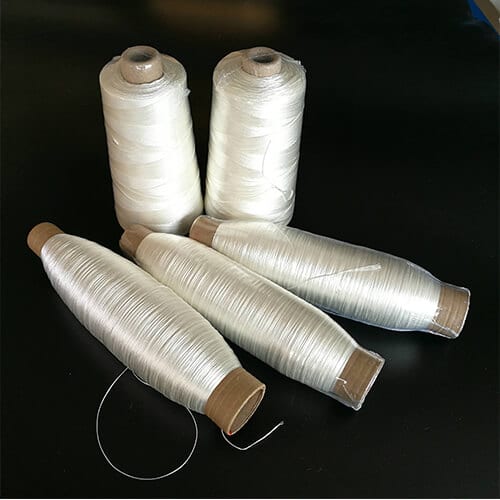
Material as supplied, photographed from our own output rather than from a stock library.
-
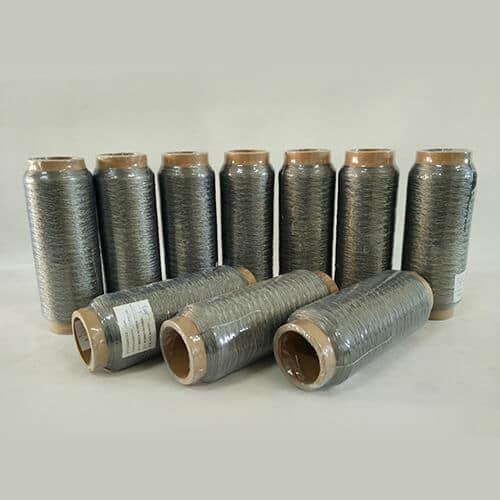
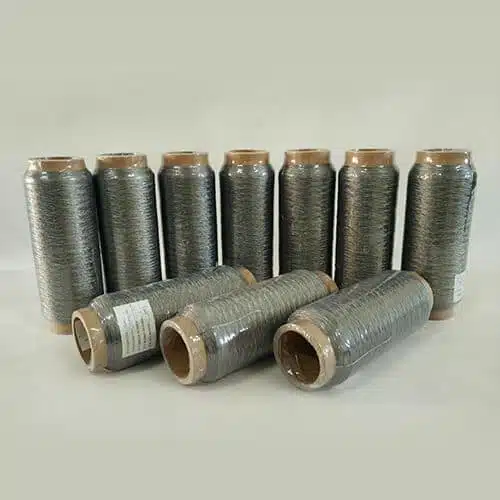
Spooled threadSupplied on spools with custom lengths to suit your machine and run length. -

Fire protection gradeThe thread used in our own welding blanket and fire curtain conversion. -
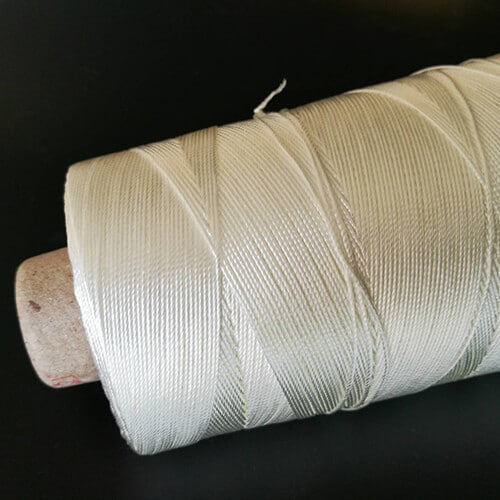
In house productionMade from the same 96 percent silica base as our cloth, so the two match. -
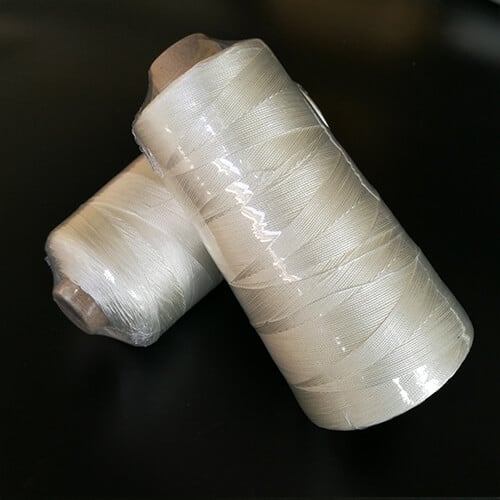
Diameter rangeFrom 0.1 mm for fine stitch work up to 3.0 mm for heavy assemblies. -
Non-combustibleInorganic by composition rather than treated, so nothing degrades over time. -
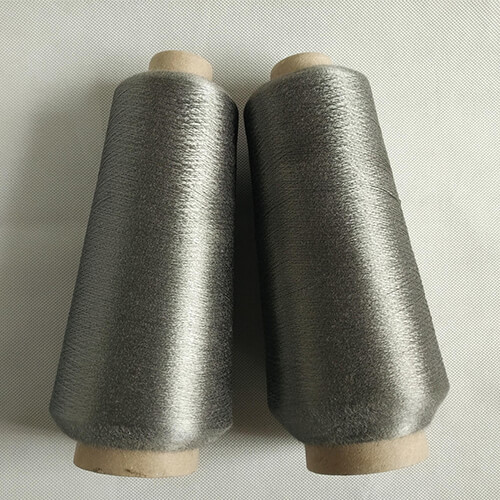
Bulk supplyWholesale and OEM volumes with custom spooling and packaging.


How to Specify the Thread
Four answers let us recommend a diameter and spooling rather than sending you the middle of the range.
- What fabric are you joining, and what is its rating? The thread should match or exceed it. If you are sewing our own high silica or fireproof cloth, tell us which and we will match it directly.
- What thickness is the material and how many layers? This drives diameter more than anything else. A single layer of 0.3 mm cloth and a four layer coated assembly need very different threads.
- What machine are you running? Industrial lockstitch, walking foot, or hand work each suit different diameters. If you are unsure, tell us the make and we will suggest a starting point.
- What spool length and volume do you need? A production line running continuously wants long spools with few changeovers. A workshop doing occasional work is better served by shorter ones that do not sit part used.
If you are trialling the material for the first time, say so. We would rather send a small quantity in the diameter most likely to work on your machine than sell a bulk order of something that turns out to need a different setup.
Wholesale and OEM Supply
SilicaPro supplies high temperature fiberglass and silica sewing thread in wholesale volumes and under OEM arrangements for manufacturers and distributors worldwide. Custom diameters, spool lengths and packaging are produced to requirement.
The advantage of buying the thread from the same plant that wove the fabric is that the two are matched by construction rather than by coincidence. Both start from the same 96 percent silica base, so a seam and the panel it joins share the same thermal behaviour and the same shrinkage characteristics. That consistency is difficult to guarantee when the fabric and the thread come from different suppliers.
Around 70 to 80 percent of our total output is exported, so the documentation, packing and inspection routines that international orders require are routine here rather than exceptional. If your quality process requires batch level documentation on tensile strength or silica purity, request it at the quotation stage.
High Temperature Sewing Thread Questions
The questions converters, manufacturers and procurement teams ask us most often.
Why can I not just use ordinary thread on high temperature fabric?
Because the seam becomes the temperature limit of the whole assembly. Polyester softens around 250 degrees Celsius and nylon is similar. Stitch a 1000 degree fabric with either and you have built a 250 degree product.
What makes this failure particularly awkward is that the fabric is usually undamaged when it happens. The panel is intact, the seam has opened, and the protective cover has come apart while looking as though nothing was wrong with the material.
What do the four temperature figures actually mean?
They describe temperature against duration, which is far more useful than a single number. Continuous service at 900 degrees means long term operation without degradation. 1450 degrees for 10 minutes is a sustained excursion. 1600 degrees for 15 seconds is peak survival. 1700 degrees is the softening point, where the material itself gives way.
Design against the figure that matches your exposure. A seam sitting permanently against a hot surface is governed by the 900 degree continuous rating, and the peak figures simply confirm a brief excursion will not destroy the assembly.
Which diameter should I choose?
We supply 0.1 mm to 3.0 mm, and the whole range shares the same thermal performance. Diameter is selected against your fabric and your machine rather than against temperature.
Finer thread suits lighter fabric and finer stitch work. Heavier thread suits thick coated material and assemblies carrying mechanical load. Tell us the fabric thickness, the number of layers and the machine you are running, and we will recommend a starting diameter.
My thread keeps breaking on the machine. What is wrong?
Almost always tension, speed or a worn thread path. Inorganic fibre has very low elongation, so it does not stretch to absorb tension spikes the way polyester does. A tension setting carried over from synthetic thread will break it.
Reduce tension considerably, slow the machine down, and check every guide and tensioner for wear grooves. A groove worn by years of synthetic thread will cut silica thread within a few metres. Those three checks resolve the large majority of breakage reports we receive.
Does the thread shrink when heated?
The heat shrinkage rate is low and the thread remains stable through thermal cycling, which is a more important property in a thread than in a fabric.
The reason is that shrinkage in a fabric distributes across the whole panel, while shrinkage in a thread acts along the stitching line. A thread that shrinks puckers the assembly, distorts the fit and concentrates stress at every individual stitch, so the failure is progressive rather than sudden.
Can I use it for anything other than sewing?
Yes, and a meaningful share of what we supply goes into non sewing applications. Winding electric heating elements, electrical insulation and cable filling, sealing within rubber hoses and gaskets, and reinforcement skeletons for fireproof tapes.
What those applications share with sewing is the requirement for a fine, non-combustible, electrically insulating fibre that holds dimensional stability under heat. The form suits several jobs beyond the one it is named after.
Is it the same material as your high silica cloth?
The same base chemistry at 96 percent SiO2 or above, produced at the same plant, presented as thread rather than as woven fabric.
That shared origin is the practical reason to buy both from one source. A seam and the panel it joins behave the same way under heat and shrink at the same rate, which is difficult to guarantee when the thread and the fabric come from different manufacturers with different processes.
Does it contain asbestos?
No. The thread is non-asbestos, non-combustible and pollution free. It is a manufactured inorganic glass fibre with the non silica oxides chemically removed.
The non-combustible property comes from composition rather than from a chemical treatment, which means it cannot wear off or wash out over the life of the product.
Can you sew the assembly for me instead?
Yes. We convert high temperature fabric into finished welding blankets, fire blankets, curtains, sleeves and insulation covers in our own workshops, stitched with this thread as standard.
For many buyers that is the better route. Setting up a workshop to sew inorganic thread reliably takes time and trial, and if your volume does not justify that investment, buying the finished item removes the problem entirely.
Can I get a sample before ordering?
Yes, and for this product we strongly recommend it. Machine setup varies enormously between workshops, and the only reliable way to establish the right tension and needle combination is to run the thread on your own equipment.
Tell us the fabric and the machine when you request a sample so we can send the diameter most likely to suit. A sample in the wrong diameter tells you very little.
What is your minimum order quantity?
It depends on whether the diameter and spooling are standard or custom. A custom diameter or a non standard spool length needs its own production run, which raises both the minimum and the lead time.
Tell us the specification and your rough volume and we will confirm the exact figure with your quotation. If you are trialling first, we treat the trial quantity separately from the production requirement.
What are your payment terms and shipping options?
Payment is normally by T/T, structured as a deposit with the balance settled before shipment. We confirm the exact split with your quotation.
EXW, FOB, CIF and DAP terms are all available, so you can pick whichever fits how your freight is already arranged. If you have a nominated forwarder we will work with them directly.
Related Products
The fabrics this thread is designed to join, and the other forms we supply from the same silica base.
Tell Us the Fabric and the Machine, and We Will Match the Thread
Send the material you are joining, its thickness and layer count, the machine you are running and your volume. We reply with a recommended diameter, pricing and a lead time we can hold to.
Request a QuotePhone
+8613758326701
Bright Sky New Material Co Ltd.
Room 1101-11, 11/F,Youbang Building. Jiaxing Headquarters Business Garden, Nanhu District, Jiaxing, Zhejiang, 314000 - China
sales@silicapro.com
lucyhhyy@gmail.com
© 2021 SILICAPRO.COM
All Rights Reserved