
SilicaPro
Quartz Fiber
Quartz Fiber, 99.9 Percent SiO2 and Above
Quartz fiber is an inorganic fiber drawn from high purity quartz or natural crystal. It retains the properties of solid quartz while adding the flexibility and processability of a textile fibre, which is an unusual combination and the reason it appears in applications nothing else can serve.
At more than 99.9 percent silicon dioxide, it sits a clear step above high silica fabric on purity, and that step buys three things: temperature capability to 1700 degrees Celsius, a linear expansion coefficient low enough to be treated as dimensionally stable, and dielectric properties good enough for radar transparent structures.
We supply the full range of forms from our plant in Jiaxing: cloth, yarn, roving, sewing thread, chopped strands, sleeve and cotton. Each is produced to the same purity specification and selected according to how the material needs to be applied rather than what it needs to withstand.

What Makes Quartz Fiber Different
Six properties define this material, and unusually for a high temperature product, only one of them is about temperature. That is the point worth understanding before specifying it.
- High tensile strength and dimensional stability. The fibre holds its dimensions under load and through thermal cycling, which matters in composite structures where the reinforcement must not move relative to the matrix.
- Low dielectric constant and dielectric loss. A dielectric constant of 3.74 and a loss factor of 0.0002 at 10 GHz. In practical terms, radar and radio frequency energy passes through the material with very little absorption, which is why radomes are built from it.
- High temperature resistance up to 1700 degrees Celsius. The softening point, well above what high silica or E-glass can offer.
- Excellent corrosion resistance. Chemically inert against most acids and aggressive media, a direct consequence of the near total absence of the other oxides that make ordinary glass vulnerable.
- Low thermal expansion coefficient. At 0.55 x 10 to the minus 6 per Kelvin, expansion under heat is small enough that the material can be treated as dimensionally stable across a wide temperature range.
- Lightweight and flexible. Density of 2.2 grams per cubic centimetre, and flexible enough to weave, braid and sew. Materials that match quartz on temperature almost never match it on handling.
The last point is the practical one. Plenty of ceramics survive 1700 degrees. Very few of them can be woven into a 0.06 mm cloth, braided into a sleeve or chopped into a 6 mm strand and dispersed through a resin. Quartz fiber is specified as often for what it lets you do with it as for what it withstands.
Quartz Fiber, High Silica or E-Glass
These three materials are frequently discussed as though they were grades of the same product. They are not, and choosing between them on price alone is how projects end up with the wrong material in service.
| Property | E-Glass | High Silica | Quartz Fiber |
|---|---|---|---|
| SiO2 content | Roughly 52 to 56 percent | More than 96 percent | More than 99.9 percent |
| Softening point | Around 840 degrees Celsius | Around 1700 degrees Celsius | Around 1700 degrees Celsius |
| Dielectric loss | Relatively high | Moderate | Very low, 0.0002 at 10 GHz |
| Thermal expansion | Moderate | Low | Very low, 0.55 x 10 to the minus 6 per K |
| Relative cost | Low | Moderate | High |
| Typical use | General insulation and reinforcement | Welding, furnace and industrial thermal protection | Radomes, circuit boards, aerospace thermal protection |
Notice that quartz and high silica share a softening point. If temperature alone is your requirement, high silica does the job at considerably lower cost and quartz fiber is an expensive way to buy nothing extra.
Where quartz earns its price is in the two columns temperature does not cover. If the material sits in a radar path, carries a high frequency signal, or has to hold dimensional tolerance through thermal cycling, high silica will not substitute for it at any thickness. That is the question to answer before comparing quotations.
Seven Forms, One Material
All forms carry the same purity specification. What differs is how the fibre is presented, and that determines how it can be applied.

Quartz Fiber Cloth
Woven fabric for thermal insulation, composite reinforcement and fire protection. The thickness range is unusually wide, running from a 0.06 mm cloth that behaves almost like tissue up to a 3 mm heavy construction.
Weave structure changes handling as much as strength. Plain is stable and easy to cut, satin drapes better around complex shapes, twill sits between the two.
0.06 to 3 mm thick, 45 to 120 cm wide, plain / twill / satin
Quartz Fiber Yarn
Supplied in four types by filament diameter, from 6 to 10.5 micron. Finer filaments give a smoother surface and better drape in the finished textile, coarser ones give higher bulk and easier handling during weaving.
Linear density and twist are both specified per type, which matters if you are weaving or braiding to a target construction.
6 to 10.5 µm filament, 10 to 500 TeX, twist 30 to 200 T/m
Quartz Roving
Low twist continuous filament for filament winding, pultrusion and composite processing. The very low twist, no more than 10 turns per metre, allows the roving to spread and wet out properly in resin.
The wide linear density range covers everything from fine reinforcement up to heavy structural work.
7 µm filament, 6 to 2400 TeX, twist 10 T/m or less
Quartz Fiber Sewing Thread
Higher twist thread built for stitching rather than weaving. The detail buyers most often overlook: a quartz fabric assembly stitched with an ordinary thread fails at the seam long before the fabric is troubled.
Twist is deliberately high, between 120 and 300 turns per metre, to survive passing through a needle repeatedly.
7 µm filament, 18 to 300 TeX, twist 120 to 300 T/m
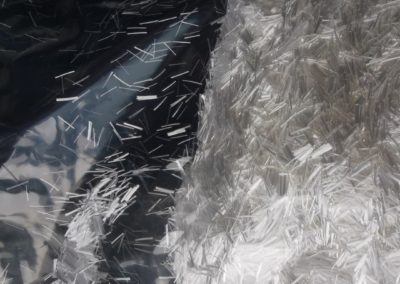
Chopped Quartz Fiber Strands
Cut fibre for reinforced plastics, friction materials and high temperature coatings, where the fibre must disperse evenly through a matrix rather than run continuously through it.
Length is specified rather than approximate, because dispersion behaviour changes noticeably between a 6 mm and a 30 mm cut.
6 to 12 µm filament, 6 to 30 mm length
Quartz Fiber Sleeve
Braided tube for cables, pipes and engine components needing both electrical and thermal insulation in one product. Slides over the item being protected rather than being wrapped around it.
The inner diameter range covers everything from a single wire up to substantial pipework.
1 to 100 mm inner diameter, 6 to 10 µm filament
Quartz Fiber Cotton
Ultra fine bulk fibre for lightweight thermal insulation, optical fibre production support and high temperature gas filtration. Available in four filament grades down to 0.7 micron.
Filament diameter drives filtration efficiency directly, so the grade choice here is a performance decision rather than a cost one.
0.7 to 8 µm filament, four grades availableMaterial Characteristics
Physical, electrical and thermal properties of our quartz fiber. These are the figures a design engineer needs, and they are the reason the material gets specified into radomes and circuit boards rather than only into insulation.
| Category | Property | Unit | Value |
|---|---|---|---|
| Physical | Density | g/cm³ | 2.2 |
| Physical | SiO2 content | % | 99.9 minimum |
| Thermal | Softening point | °C | 1700 |
| Thermal | Linear expansion coefficient | K⁻¹ | 0.55 × 10⁻⁶ |
| Thermal | Specific heat at 20°C | J·kg⁻¹·K⁻¹ | 670 |
| Thermal | Thermal conductivity at 20°C | W·m⁻¹·K⁻¹ | 1.4 |
| Electrical | Dielectric constant at 10 GHz | — | 3.74 |
| Electrical | Dielectric loss factor at 10 GHz | — | 0.0002 |
| Electrical | Dielectric strength | V·m⁻¹ | 3.7 × 10⁷ |
| Electrical | Resistivity at 20°C | Ω·m | 1 × 10²⁰ |
| Electrical | Resistivity at 1000°C | Ω·m | 1 × 10⁸ |
Two of these figures deserve comment. The dielectric loss factor of 0.0002 is what makes radar transparent structures possible: energy passing through the material is barely absorbed, so a radome protects the antenna without blinding it. And the resistivity figures show the material remains an effective insulator even at 1000 degrees, dropping from 10 to the 20 down to 10 to the 8, which is still enormously high for a material at that temperature.
| Yarn Type | Filament Diameter (µm) | Linear Density (TeX) | Twist (T/m) |
|---|---|---|---|
| Type A yarn | 6 ± 1 | 10 to 400 | 30 to 200 |
| Type B yarn | 7 ± 1 | 10 to 400 | 30 to 200 |
| Type C yarn | 8 ± 1 | 30 to 500 | 30 to 160 |
| Type D yarn | 10 ± 1.5 | 50 to 500 | 30 to 160 |
| Roving | 7 ± 1 | 6 to 2400 | 10 or less |
| Sewing thread | 7 ± 1 | 18 to 300 | 120 to 300 |
| Chopped fiber | 6 to 12 | — | — |
Actual Test Results, Not Just Standards
Most suppliers publish the standard their material is supposed to meet. Below is our published standard alongside the measured result from testing on chopped quartz fiber strands, so you can see the margin rather than take it on faith.
| Item | Unit | Standard | Test Value |
|---|---|---|---|
| SiO2 content | % | 99.9 minimum | 99.92 |
| Diameter | µm | 10.5 ± 1.00 | 10.7 |
| Length | mm | 6 to 30 | 6.4 |
| Moisture content | % | — | 0.60 |
| Combustible matter content | % | 1.0 ± 0.5 | 1.01 |
Look at the SiO2 row. The standard is 99.9 percent minimum and the measured value is 99.92 percent. That is a margin of two hundredths of a percentage point, and publishing it rather than rounding it up to a comfortable number is deliberate.
The same applies to the diameter figure. The standard permits 10.5 micron plus or minus one, and the measured value is 10.7, comfortably inside tolerance but not exactly on nominal. Real production data looks like this. A specification sheet where every measured value lands precisely on the nominal figure has usually been written rather than measured.
If you require test data for a specific batch or a specific product form, ask at the quotation stage and we will provide it. Buyers in aerospace and electronics frequently need this documentation for their own approval process, and we would rather supply it up front than be asked for it after the material has shipped.
Quartz Fiber in Production
Material from our own production, photographed as supplied rather than as marketing renders.
-
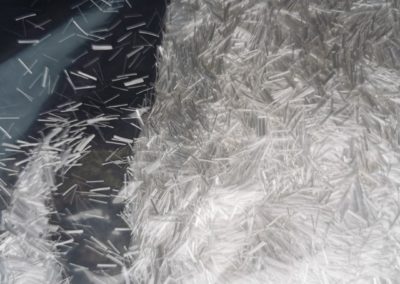
Quartz fiber -
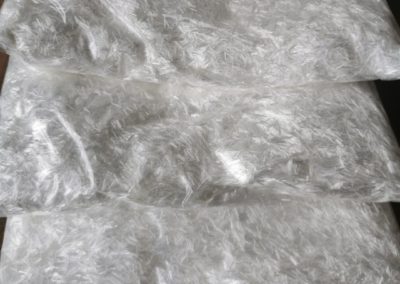
Silica glass fiber -
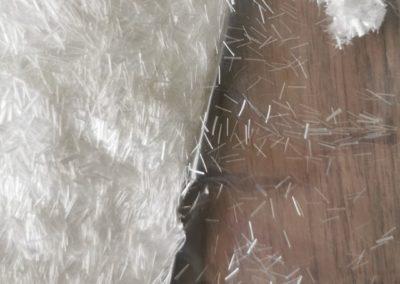
Quartz filament -
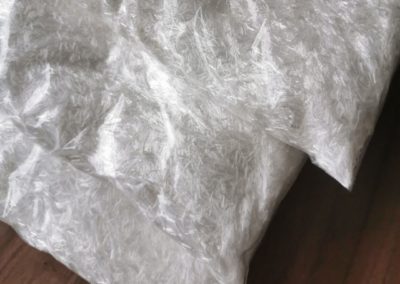
Chopped strands -
High purity silica fiber
Quartz fiber demonstration, filmed on our own material. A datasheet states properties. Footage shows how the material actually behaves in the hand.
Applications
Quartz fiber appears wherever purity, dielectric performance or dimensional stability matter as much as temperature. These are the applications we supply most often.
Missile, Aircraft and Satellite Radomes
The application the dielectric properties exist for. A radome must protect an antenna from heat and impact while remaining effectively invisible to the radar it houses. Very few materials manage both.
High Frequency Circuit Boards
Low expansion, low dielectric loss substrates for high frequency electronics, where signal integrity degrades quickly if the substrate absorbs energy or shifts dimension with temperature.
Electromagnetic Windows
Interference and anti interference systems requiring a structural material that lets electromagnetic energy pass through in a controlled and predictable way.
Rocket and Aircraft Engine Thermal Protection
Thermal protection systems in propulsion environments, where the combination of extreme heat, vibration and weight constraint rules out most alternatives.
Optical Fiber Manufacturing
Process support and thermal insulation in optical fibre production, an environment where contamination from the insulating material itself would be unacceptable.
Automotive Glass Manufacturing
High temperature handling and process insulation in glass production lines, where the material contacts hot glass without marking or contaminating it.
High Temperature Gas Filtration
Quartz fiber cotton in fine filament grades for filtering hot gas streams, where the filter medium has to survive the temperature it is filtering.
Cable and Engine Insulation
Braided sleeve providing electrical and thermal insulation simultaneously for cables, pipes and engine components in confined high temperature spaces.
Silicate and Asbestos Replacement
A direct substitute in applications where older silicate or asbestos fibres are being phased out for regulatory or health reasons, without giving up temperature capability.
How to Specify Quartz Fiber
This is a material where a vague inquiry produces a vague quotation. Five answers let us specify properly and price accurately.
- Which form do you need? Cloth, yarn, roving, sewing thread, chopped strand, sleeve or cotton. If you are unsure, describe how the material will be applied and we will identify the form. This is the single most important answer.
- What is the operating temperature, and is it continuous or transient? Sustained service and short excursion are different design problems, and confusing the two produces either an under specified material or an unnecessarily expensive one.
- Are dielectric properties relevant? If the material sits in a radar path or carries a high frequency signal, say so at the start. This is usually the reason quartz is the right answer rather than high silica, and it changes what we recommend.
- What dimensional tolerance do you need? For cloth, the thickness, width and weave structure. For yarn and roving, the linear density and twist. For chopped strand, the length. For sleeve, the inner diameter.
- What documentation does your approval process require? Aerospace and electronics buyers usually need batch test data, and arranging it up front is far easier than retrofitting it after shipment.
If you can only answer some of these, send what you have. A description of the problem is often more useful than a half completed specification, because it lets us suggest something you may not have considered.
Wholesale and OEM Supply
We supply quartz fiber as bulk material and under OEM and private label arrangements, to industrial buyers across aerospace, electronics, filtration and insulation sectors. Around 70 to 80 percent of our total output is exported, so the documentation and packing routines international orders require are routine here.
Custom specifications are available across every product form. For cloth that means non standard thicknesses, widths and weave structures. For yarn and roving it means linear density and twist to your requirement. For chopped strand it means cut length, and for sleeve it means inner diameter. Custom specifications need their own production run, which affects both minimum quantity and lead time, and we will be specific about both rather than quoting a generic figure.
Private labelling covers packaging, labelling and carton marking to your artwork. If your buyer requires particular documentation with the shipment, tell us at the quotation stage so it can be prepared alongside the goods rather than chased afterwards.
Quartz Fiber Questions
The questions design engineers and procurement teams ask us most often about this material.
What is the difference between quartz fiber and high silica fabric?
Purity, and what that purity buys. High silica sits above 96 percent SiO2, quartz fiber above 99.9 percent. Both share a softening point around 1700 degrees Celsius, so on temperature alone they are comparable.
The difference shows in the electrical and dimensional properties. Quartz fiber has a dielectric loss factor of 0.0002 and a linear expansion coefficient of 0.55 x 10 to the minus 6 per Kelvin, both far better than high silica can offer. If your application needs radar transparency, high frequency signal integrity or tight dimensional stability, quartz is necessary. If it needs heat resistance only, high silica does the same job for considerably less money.
Why is quartz fiber used in radomes?
Because it solves two problems that usually conflict. A radome has to survive aerodynamic heating and physical impact, which normally means a dense structural material, and it has to let radar energy pass through unimpeded, which normally means the thinnest possible barrier.
With a dielectric constant of 3.74 and a loss factor of 0.0002 at 10 GHz, quartz fiber absorbs very little of the energy passing through it. The antenna behind the radome sees essentially what it would see without one, while the structure still protects it. Very few materials manage both at once.
What thickness of quartz fiber cloth do you supply?
From 0.06 mm to 3 mm, in widths from 45 to 120 cm, in plain, twill and satin weave structures.
That range is wider than it may appear. A 0.06 mm cloth is close to tissue in weight and is used where the fabric must not add bulk, typically in electronics and precision composites. A 3 mm construction is a substantial structural fabric. Tell us the application and we will suggest a thickness, since buyers frequently specify heavier than they need.
Which weave structure should I choose?
Plain weave is the most stable and the easiest to cut and handle, and it is the usual default for flat applications. Satin drapes considerably better, which matters when the fabric has to conform around a curved or complex shape without wrinkling. Twill sits between the two.
If the fabric is going into a composite layup over contoured tooling, satin is usually worth the extra handling care. For flat insulation or straightforward reinforcement, plain is the sensible choice.
Can quartz fiber replace asbestos?
It is used as a replacement for silicate and asbestos fibres in a range of applications, and that substitution is a meaningful part of current demand as older materials are phased out.
Whether it substitutes in your specific case depends on what the original material was doing. If the requirement was heat resistance and electrical insulation, quartz fiber generally covers it. If the requirement included something asbestos did particularly well and quartz does not, the substitution may need engineering rather than a straight swap. Describe the application and we will give you an honest view.
What is the difference between yarn, roving and sewing thread?
Twist, mainly. Yarn carries a moderate twist of 30 to 200 turns per metre and is intended for weaving and braiding. Roving carries almost none, 10 turns per metre or less, so it spreads and wets out properly in resin during composite processing. Sewing thread carries high twist, 120 to 300 turns per metre, so it survives repeated passage through a needle.
Using the wrong one causes predictable problems. Roving used as sewing thread breaks. Sewing thread used in a composite does not wet out properly and leaves dry spots.
What filament diameter should I specify for quartz fiber cotton?
We supply four grades: 0.7 to 1, 1 to 3, 3 to 5 and 5 to 8 micron. The choice is a performance decision rather than a cost saving one.
Finer filaments give higher filtration efficiency and lower thermal conductivity, at the cost of higher pressure drop across a filter and more difficult handling. Coarser filaments are easier to work with and let more through. For gas filtration, tell us the particle size you need to capture and the pressure drop you can tolerate, and the grade follows from those two numbers.
Can I get batch test data with my order?
Yes, and for aerospace and electronics customers it is usually necessary rather than optional. Request it at the quotation stage so it can be prepared alongside the goods.
We publish standard against measured values openly, as shown in the quality data section above. A supplier reluctant to provide batch level test results is worth questioning further, because in a material where purity is the entire value proposition, the numbers are the product.
Can I get a sample before ordering?
Yes. Samples of standard specifications are normally available, and for a material at this price point we would strongly prefer you tested it rather than took our datasheet on trust.
Tell us the intended application when you request one. Handling differs considerably between forms and between weave structures, and a sample matched to your actual process tells you far more than a generic swatch.
What is your minimum order quantity?
It depends on the form and whether the specification is standard or custom. Standard specifications carry a lower minimum. A custom cloth thickness, a non standard yarn linear density or a specific chopped length each need their own production run, which raises both the minimum and the lead time.
Tell us the form, the specification and your rough volume and we will confirm the exact figure with your quotation.
Do you supply quartz fiber outside these seven forms?
The seven forms cover the great majority of requirements, but if your application needs something else, ask rather than assuming it is unavailable.
We also produce a matching quartz fiber sewing thread specifically so that fabric assemblies can be stitched without introducing a weak point, which is the kind of gap that only becomes obvious once you have tried to build something. If you have found a similar gap, tell us.
What are your payment terms and shipping options?
Payment is normally by T/T, structured as a deposit with the balance settled before shipment. We confirm the exact split with your quotation.
EXW, FOB, CIF and DAP terms are all available, so you can pick whichever fits how your freight is already arranged. If you have a nominated forwarder we will work with them directly.
Related Products
If quartz fiber is more than your application requires, these are the alternatives worth considering.
Tell Us the Application and We Will Specify the Form
Send the operating conditions, whether dielectric performance matters, the form you need and your target volume. We reply with a specification, pricing and a lead time we can hold to.
Request a QuotePhone
+8613758326701
Bright Sky New Material Co Ltd.
Room 1101-11, 11/F,Youbang Building. Jiaxing Headquarters Business Garden, Nanhu District, Jiaxing, Zhejiang, 314000 - China
sales@silicapro.com
lucyhhyy@gmail.com
© 2021 SILICAPRO.COM
All Rights Reserved