
SilicaPro
Nano-Microporous Insulation Board
Nano-Microporous Insulation Board, Also Known as Microporous Silica Board
Nano-microporous insulation board is a rigid or flexible panel built from chains of amorphous fumed silica agglomerates, with individual particles measuring 7 to 12 nanometres, combined with an opacifier that suppresses infrared radiation.
The result is a material with thermal conductivity three to four times lower than conventional insulation, and in most of its operating range, lower than still air. That last claim sounds impossible if you know anything about insulation, which is why we explain the physics behind it further down this page rather than simply asserting it.
Supplied in two grades, HT-1000 rated to 1000 degrees Celsius and MT-800C rated to 800, in thicknesses from 10 to 50 mm and four standard panel sizes. Used across steelmaking, petrochemical, non-ferrous, cement, ceramics, glass, aerospace and appliance manufacturing.

Lower Thermal Conductivity Than Still Air
This is the claim that makes the product worth its price, and it deserves a proper explanation rather than a bullet point. Still air has a thermal conductivity of roughly 0.026 W/mK at room temperature, and it is the benchmark every conventional insulation material is trying to approach.
Mineral wool, ceramic fibre and foam all work the same way. They trap air in pockets and stop it moving, because still air insulates well and moving air does not. Under that model, still air is a floor. No material built from trapped air can beat it, because the trapped air is doing the insulating.
Nanoporous silica breaks that floor, and the reason is the size of the pores.
Air molecules transfer heat by colliding with each other. At normal pressure, a molecule travels roughly 70 nanometres between collisions. That distance is called the mean free path, and it is what makes still air conduct heat at all.
The pores in this material are smaller than that distance. An air molecule inside a nanopore hits the pore wall before it can reach another molecule, so the collision that would have transferred heat never happens. The gas is still there, but it has largely stopped conducting.
That is why the measured figure at 200 degrees, below 0.020 W/mK, sits under the conductivity of the air the material contains. It is not a marketing exaggeration. It is a consequence of building pores smaller than the distance a gas molecule travels.
The opacifier handles the other half of the problem. At high temperature, a significant share of heat moves by infrared radiation rather than conduction, and a material that only stops conduction leaks badly once it gets hot. The silicon carbide content, at 10 to 30 percent, absorbs and scatters that radiation so the panel keeps performing as temperature climbs rather than losing effectiveness where it is needed most.
Together, those two mechanisms give a material described as close to the lowest thermal conductivity theoretically possible in any material across its operating range.
Two Grades: HT-1000 and MT-800C
Both share the same nanoporous fumed silica structure and the same composition. The difference is the temperature ceiling, and with it the density and the price.
HT-1000
High temperature gradeRated to 1000 degrees Celsius maximum application temperature, with thermal conductivity lower than still air across most of the 50 to 1000 degree range.
The grade for steelmaking, where ladles, tundishes and torpedo ladles operate at the top of the range and nothing below 1000 degrees will serve.
MT-800C
Medium temperature gradeRated to 800 degrees Celsius, with the same nanoporous structure and the same conductivity advantage across the 50 to 800 degree range.
Lighter at around 250 kg per cubic metre, and the sensible choice wherever the process genuinely stays below 800 degrees rather than approaching it.
Choose on your actual maximum rather than on headroom. Specifying HT-1000 for a 700 degree process costs more and buys nothing you will use, while specifying MT-800C for a process that occasionally touches 850 degrees is a false economy that ends with a lining replacement.
Thermal Conductivity at Temperature
Measured to YB/T4130-2005, with temperature stated on the hot side. Conductivity rises with temperature in every insulation material, so a single figure quoted without a temperature is close to meaningless.
| Hot side temperature | HT-1000 (W/mK) | MT-800C (W/mK) |
|---|---|---|
| 200 degrees Celsius | Below 0.020 | 0.023 |
| 400 degrees Celsius | Below 0.026 | 0.028 |
| 600 degrees Celsius | Below 0.032 | 0.033 |
| 800 degrees Celsius | Below 0.038 | 0.040 |
Notice how gradually those numbers climb. From 200 to 800 degrees, a span of 600 degrees, HT-1000 roughly doubles. Conventional fibre insulation typically deteriorates far more steeply across the same range, because radiation becomes the dominant heat transfer mode at high temperature and a fibre blanket does little to stop it. The opacifier is what flattens this curve.
| Thermal shrinkage | HT-1000 | MT-800C |
|---|---|---|
| 24 hour full soak | 3.0 percent or less at 1000°C | 3 percent or less at 800°C |
| 24 hour one side heating | 2.0 percent or less, ASTM C356 | 2 percent or less at 800°C |
Shrinkage matters more in board than in blanket. A panel that shrinks opens a gap at every joint, and a gap in an insulation lining is a direct heat path that bypasses the material entirely. Under three percent on a full soak means the joints stay closed through service.
What Lower Conductivity Actually Buys You
Insulation performance is interesting to engineers. What persuades a plant manager is what that performance does to thickness, weight, installation time and freight, and those effects compound.
Far Less Thickness
Matching the performance of conventional insulation takes a fraction of the thickness. In equipment where internal space is fixed and every millimetre of lining is volume lost from the process, that translates directly into capacity.
Far Less Weight
Same performance at greatly reduced mass. On a mobile vessel such as a ladle or a torpedo car, lining weight is weight that has to be lifted and moved every cycle for the life of the equipment.
Fewer Components
A thinner lining needs fewer layers and fewer pieces, which speeds installation and reduces the number of joints. Every joint is a potential heat path, so fewer of them improves the finished result as well as the schedule.
Lower Freight and Storage
Light and compact material costs less to ship and takes less warehouse space. On an international order this offsets a meaningful share of the price difference against conventional insulation.
Clean Installation
The installation process is clean and contains no harmful substances. Panels are cut and fitted rather than packed and dusted, which matters to the people doing the work.
Easy to Cut and Fit
Cuts and installs quickly with ordinary tools. We also supply pre cut, drilled and specially shaped pieces to drawing, which removes the site work entirely on complex geometry.
Compare on installed cost rather than on price per square metre. Microporous board costs more per panel than mineral wool or ceramic fibre, and that comparison is the one most buyers make first.
The comparison that decides the project is different: thickness required to hit the target, labour hours to install it, freight for the volume, warehouse space while it waits, and process capacity gained or lost to lining thickness. On that basis the answer frequently goes the other way, and we would rather help you run that calculation than argue about the panel price.
Technical Specifications
Shared specification for both grades. Sizes, thicknesses, surface finishes and special shapes are all produced to order.
| Property | Specification |
|---|---|
| Appearance | Grey core material panel |
| Composition | SiO2 60 to 80 percent, SiC 10 to 30 percent, others 5 to 10 percent |
| Particle structure | Amorphous fumed silica agglomerate chains, 7 to 12 nm particles |
| Standard sizes | 1200 x 1000 mm, 1200 x 500 mm, 1000 x 600 mm, 600 x 500 mm |
| Thickness | 10 mm to 50 mm |
| Dimensional tolerance | Plus or minus 3 mm on block dimensions |
| Thickness tolerance | Plus or minus 1 mm |
| Forms available | Rigid board and flexible board |
| Special processing | Cutting, drilling and special shapes to customer drawing |
| Hydrophobic treatment | Available on some products where moisture resistance is required |
| Fibre content | Contains no respirable fibre |
| Combustibility | Non-combustible, suitable for thermal insulation and fire stop |
| Test standard | Thermal conductivity to YB/T4130-2005, shrinkage to ASTM C356 |
| OEM and wholesale | Available, with customisable sizes, surface coatings and packaging |
Surface Finishing Options
The core panel is fragile by nature, because everything that makes it insulate well also makes it low density. Surface finishing protects it in handling and installation, and the right choice depends on where the panel sits.
Uncoated Panel
Bare core material. Lowest cost and the option to specify when the panel sits fully enclosed inside a structure and will not be handled after fitting.
POF or PE Shrink Film
Film wrapping that protects the panel through transport and handling. The usual default for shipped goods, and easily removed on site if required.
Aluminium Foil
Foil facing that adds a reflective surface against radiant heat and gives a more durable face than film. A common choice for panels that remain visible in the assembly.
Aluminium Composite Film
Stronger than plain foil, with better resistance to tearing and puncture during installation. Suited to panels that get handled repeatedly or fitted into tight spaces.
Glass Fibre Cloth
Fabric facing that gives the toughest surface of the options here and tolerates the highest temperature. We weave the cloth ourselves, so this facing comes from the same plant as the board.
No Respirable Fibre
This is a genuine differentiator rather than a general safety statement, and it is worth understanding why it carries weight in this market specifically.
The material this product most often replaces is refractory ceramic fibre. Ceramic fibre performs well thermally and has been the default high temperature insulation for decades, but some refractory ceramic fibres face classification and handling restrictions in various markets because of the respirable fibres they can release during cutting, installation and removal.
Nano-microporous board contains no respirable fibre at all. It is not a treated or encapsulated version of a fibre product. The structure is built from nanoparticle agglomerates rather than from drawn fibres, so there is nothing present to become airborne in the first place.
The practical consequences reach beyond the installation crew. Fewer handling controls, simpler removal at end of life, no classification burden to manage in the destination market, and no requirement to explain the material to a safety officer who has learned to be cautious about high temperature insulation.
The components are not considered hazardous under prescribed operating conditions. Request the product MSDS if your approval process requires it, and we will supply it with the quotation.
The product should not come into contact with liquid during installation or service. Nanoporous silica is highly absorbent by structure, and water entering the pores destroys the insulating mechanism that makes the material work.
If your application involves moisture exposure, hydrophobic treatment is available on some products and should be specified at order stage rather than added later. Tell us the conditions and we will confirm whether treatment is available for the grade you need.
Application Industries
Ten sectors, spanning heavy industry through to consumer appliances and aerospace instrumentation.
Steel
Ladles, tundishes and torpedo ladles. The most demanding application on this list, and the reason the HT-1000 grade exists.
HT-1000Chemical and Petrochemical
Cracking furnace insulation, where thin section performance frees internal volume that would otherwise be lost to lining thickness.
HT-1000 or MT-800CNon-Ferrous Metals
Melting furnaces, holding furnaces, casting ladles and launders across aluminium, copper and other non-ferrous production.
HT-1000 or MT-800CCement and Mineral
Rotary kiln insulation, where continuous operation makes every percentage point of heat loss a permanent running cost.
HT-1000 or MT-800CCeramics
Tunnel kiln linings. Thinner insulation means more usable kiln volume in a fixed shell, which raises throughput without new equipment.
HT-1000 or MT-800CGlass
Melting furnaces, distribution launders and bending ovens, where thermal stability directly affects product consistency.
HT-1000 or MT-800CHigh Temperature Instruments
Temperature data recorders and thermal batteries, where the insulation has to protect electronics inside a very small envelope.
HT-1000 or MT-800CDomestic Appliances
Storage heaters and radiant cookers. Thin section performance lets a manufacturer reduce product size without losing efficiency.
MT-800CAviation and Navigation
Flight recorders and instrument protection, where the whole point is surviving an extreme thermal event inside a minimal envelope.
HT-1000 or MT-800COther Applications
Fuel cells, elevator shaft fire doors and rescue capsules, where non-combustibility and fire stop capability matter alongside insulation.
HT-1000 or MT-800CInsulation Board From Our Production
Material as supplied, photographed from our own output rather than from a stock library. Most panels here carry a foil or film facing, which is how board is normally shipped and handled.
-
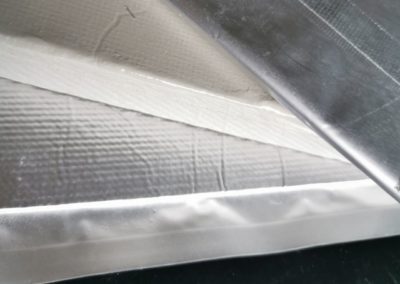
Foil faced panelThe reflective facing protects the low density core through handling and installation. -
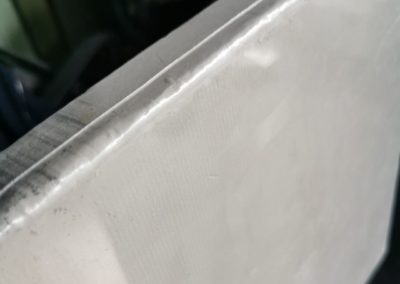
Sealed edgesFacing folded and sealed at the corners, keeping the core enclosed on every face. -
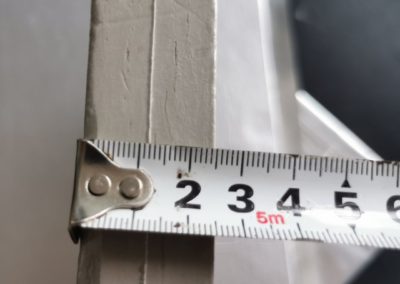
Thickness checkedPanels are produced from 10 to 50 mm and held to a tolerance of plus or minus 1 mm. -
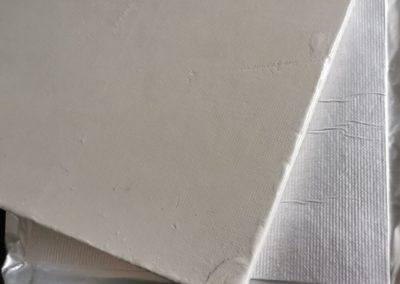
Flat panel surfaceA flat, even face is what allows panels to sit together without gaps across a lining. -
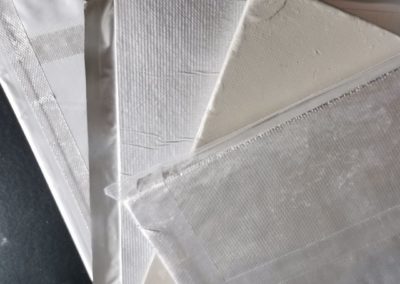
Stacked panelsBoards are stacked flat rather than stood on edge, since the core is fragile by design. -
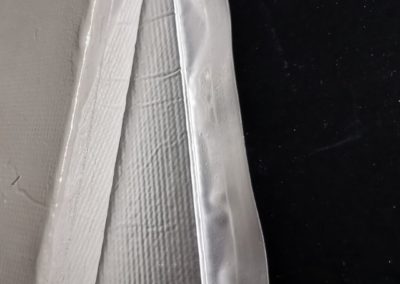
Film wrappedShrink film keeps the panel sealed and clean through transport and storage. -
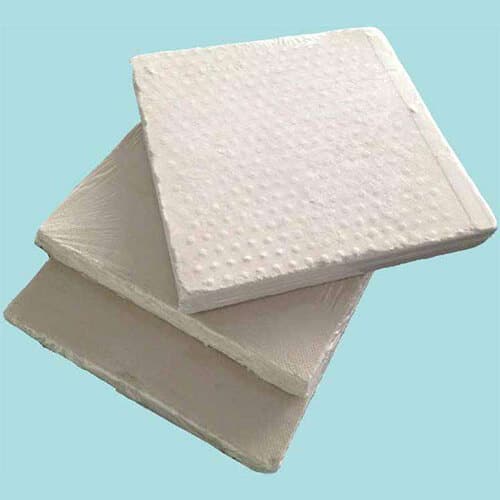
Surface finishesPlain and textured faces are both available, specified against how the panel is fitted. -

Thickness rangeSupplied across the full 10 to 50 mm range, in four standard sizes or cut to drawing.


How to Specify Insulation Board
Five answers let us recommend a grade, thickness and finish rather than sending you the middle of the range.
- What is the hot face temperature, and what is the genuine maximum? This decides between HT-1000 and MT-800C. Include occasional peaks and upset conditions rather than only the normal operating figure, because a lining specified to the average fails at the peak.
- What cold face temperature do you need to achieve? With the conductivity figures on this page and your hot face temperature, we can calculate the thickness required rather than guessing. This is the calculation that decides the order.
- How much space is available? Often the constraint is dimensional rather than thermal. If you have a fixed cavity and a target cold face temperature, the question becomes whether the performance fits the space, and this material usually wins that comparison.
- Will the panel be handled after fitting, or fully enclosed? This drives the surface finish. Fully enclosed panels can be uncoated. Panels that get handled, or that remain accessible, need foil, composite film or glass cloth facing.
- Is moisture present at any stage? During installation, in storage, or in service. Water destroys the insulating mechanism, so if moisture is a risk, hydrophobic treatment must be specified at order stage rather than added afterwards.
If you are replacing existing insulation, tell us what is there now and how thick it is. Comparing against a known material gives us a far more useful starting point than a specification written from scratch, and it lets us show you the thickness reduction in your own terms.
Wholesale and OEM Supply
SilicaPro is a silica based thermal insulation manufacturer specialising in nano-microporous board for high temperature industrial applications, with OEM manufacturing and wholesale supply available worldwide.
Customisation covers panel size, thickness, surface coating, special shapes and packaging. Cutting, drilling and profiled pieces are produced to drawing, which is worth considering for complex geometry. Site cutting of a low density panel produces waste and inconsistent joints, while factory cut pieces arrive ready to fit.
One advantage specific to this product is that we weave the glass fibre cloth facing ourselves. When you specify a cloth faced panel, the facing and the board come from the same plant rather than from two suppliers with different tolerances, which matters when the panels have to sit together cleanly across a large lining.
Around 70 to 80 percent of our total output is exported. Board is a bulky product to ship, so tell us the destination early and we will advise on the most efficient packing configuration for your volume.
Microporous Insulation Board Questions
The questions engineers, plant managers and procurement teams ask us most often.
How can a material insulate better than still air?
Because the pores are smaller than the distance an air molecule travels between collisions. Air conducts heat when its molecules collide with one another and pass energy along, and at normal pressure a molecule covers roughly 70 nanometres between collisions.
In a nanoporous structure, a molecule hits the pore wall before it reaches another molecule, so that energy transfer largely stops happening. The air is still present but it has been prevented from doing what makes air conduct. Conventional insulation traps air and stops it moving, which is a different and less effective mechanism.
Should I choose HT-1000 or MT-800C?
Choose on your genuine maximum temperature including upset conditions, not on comfort. HT-1000 works to 1000 degrees Celsius, MT-800C to 800.
If your process runs at 700 degrees and stays there, MT-800C is the correct choice and HT-1000 costs more for capability you will never use. If your process runs at 750 but occasionally touches 850, the cheaper grade is a false economy that ends in a lining replacement. Tell us both the normal and the peak figure.
How thick a panel do I need?
That is a calculation rather than a catalogue lookup, and it needs three inputs: your hot face temperature, the cold face temperature you need to achieve, and the conductivity of the material at those temperatures.
The conductivity figures are published on this page at four temperature points specifically so that you can run the calculation yourself. If you would rather we did it, send the hot face temperature, the target cold face temperature and the available space, and we will come back with a thickness.
How does it compare with ceramic fibre?
Considerably better thermally, at three to four times lower conductivity, which means far less thickness for the same result. It also contains no respirable fibre, which matters increasingly as some refractory ceramic fibres face classification and handling restrictions in various markets.
Ceramic fibre remains cheaper per unit and more tolerant of physical abuse and moisture. If space is plentiful, the environment is rough or wet, and cost is the driver, ceramic fibre is still a reasonable answer. Where space is constrained or the handling burden of fibre is a problem, microporous board is usually the better choice.
Why can it not get wet?
Because the insulating mechanism depends on the nanopore structure, and water entering those pores destroys it. A wet panel is not a temporarily impaired panel, it is a panel that has lost the property it was bought for.
Keep the material dry during installation and in service. If moisture exposure is unavoidable, hydrophobic treatment is available on some products, but it must be specified at order stage because it is part of the manufacturing process rather than a coating applied afterwards.
Which surface finish should I specify?
It depends on handling rather than on thermal performance. Uncoated is fine for panels fully enclosed inside a structure that will not be touched again. Shrink film protects through transport. Aluminium foil adds a reflective face and better durability. Aluminium composite film resists tearing during difficult installations. Glass fibre cloth gives the toughest and most temperature tolerant facing.
The core panel is fragile because low density is what makes it insulate well. If the panel will be handled repeatedly or fitted into a tight space, spend on the facing rather than replacing damaged panels.
Does it contain respirable fibre?
No. The structure is built from nanoparticle agglomerates rather than from drawn fibres, so there is nothing present that can become an airborne respirable fibre during cutting, installation or removal.
The components are not considered hazardous under prescribed operating conditions. Request the product MSDS if your approval process requires documentation, and we will supply it with the quotation.
Can you supply pre cut and shaped pieces?
Yes. Cutting, drilling and special shapes are produced to your drawing, and for complex geometry this is usually worth doing.
Site cutting of a low density panel produces waste and inconsistent joints, and every joint is a heat path. Factory cut pieces arrive ready to fit, install faster and generally produce a better finished lining than the same material cut on site.
Is it more expensive than conventional insulation?
Per panel, yes. On installed cost, frequently not, and the comparison is worth running properly.
Account for the thickness needed to reach your target, the labour hours to install it, freight for the volume, warehouse space while it waits, and any process capacity gained or lost to lining thickness. Where internal space has value, such as in a kiln or a furnace where a thinner lining means more usable volume, the calculation frequently favours microporous board despite the higher panel price.
What is the difference between rigid and flexible board?
Both are available. Rigid board holds its own shape and suits flat linings and structural positions. Flexible board conforms to curved surfaces such as vessel walls and ducting without needing to be cut into segments.
Tell us the geometry of the surface being lined and we will recommend the form. A curved surface lined with rigid board needs many small pieces and many joints, while flexible board wraps it in far fewer.
What is your minimum order quantity?
Standard sizes and thicknesses carry a lower minimum because the material already exists in that form. Custom sizes, special shapes and hydrophobic treatment need their own production run, which raises both the minimum and the lead time.
Tell us the specification and rough volume and we will confirm the exact figure with your quotation. Note that customised production to your use scale is available subject to a certain minimum quantity, which we will state clearly rather than leave vague.
What are your payment terms and shipping options?
Payment is normally by T/T, structured as a deposit with the balance settled before shipment. We confirm the exact split with your quotation.
EXW, FOB, CIF and DAP terms are all available. Board is bulky relative to its weight, so tell us the destination early and we will advise on the most efficient packing configuration for your volume.
Related Products
Materials ordered alongside insulation board, including the fibre that goes into it and the cloth used to face it.
Send Us the Temperatures and We Will Calculate the Thickness
Tell us the hot face temperature, the cold face temperature you need to reach, the space available and whether moisture is present. We reply with a grade, a thickness, pricing and a lead time we can hold to.
Request a QuotePhone
+8613758326701
Bright Sky New Material Co Ltd.
Room 1101-11, 11/F,Youbang Building. Jiaxing Headquarters Business Garden, Nanhu District, Jiaxing, Zhejiang, 314000 - China
sales@silicapro.com
lucyhhyy@gmail.com
© 2021 SILICAPRO.COM
All Rights Reserved