
SilicaPro
Silicone Cloth
Silicone Cloth for Sealing, Flexing and Electrical Insulation
Silicone cloth is high strength fibreglass fabric calendered or coated with silicone rubber, producing a composite that behaves like neither material on its own. It has the flexibility and sealing capability of rubber with the tensile strength and dimensional stability of glass fibre behind it.
Operating from minus 70 up to plus 260 degrees Celsius, rated to 300 kPa working pressure, and with a dielectric breakdown strength of 20 to 50 kV per millimetre. Available with single sided or double sided coating, which is the specification that most often decides whether the material performs as intended.
Used across aerospace, chemical processing, large scale power generation, machinery, and metallic and non-metallic expansion joints. Supplied in eight standard colours plus transparent, or custom to requirement.

This Is Not a High Temperature Product
Worth saying plainly, because we also make fabrics rated to 1000 degrees Celsius and this one stops at 260. If you arrived here looking for heat resistance and nothing else, our high silica cloth is the better answer and it is not close.
Silicone cloth solves a different problem. It seals, it flexes through millions of cycles, it holds pressure, it insulates electrically, and it survives a decade of outdoor weather. High silica cloth does none of those things, because bare woven glass has no sealing capability, no pressure retention and no elasticity.
What you are buying here is the combination. The silicone rubber contributes elasticity, sealing and weather resistance. The fibreglass contributes tensile strength and stops the rubber stretching out of shape or tearing. Neither material alone would do the job, and that is precisely why the composite exists.
The practical test is what the material has to do rather than what temperature it faces. If the answer involves sealing a gap, absorbing movement, holding pressure, or insulating a conductor, this is the product regardless of whether your temperature is 80 degrees or 240.
If the answer involves nothing more than surviving heat, you are paying for elasticity and sealing you will never use. Tell us which situation applies and we will point you at the right material even when that means a cheaper one.
Single Sided or Double Sided
The single most consequential choice on this page, and the one most often specified incorrectly. The two are not simply different amounts of the same coating. They are intended for opposite positions in an assembly.
Single Sided Coating
Silicone rubber applied to one face, leaving the other as bare fibreglass. The coated face takes the environmental exposure while the uncoated face bonds readily to adhesives and adjacent layers.
This is the specification for the outer protective layer of flexible fabric compensators, where the coating faces outward against weather and the raw side sits against the rest of the assembly.
Outer protective layersDouble Sided Coating
Silicone rubber on both faces, fully encapsulating the glass fabric. Nothing can pass through the material and neither face has exposed fibre.
This is the specification for inner sealing layers, where the fabric has to be gas tight and both surfaces are in contact with the medium being contained rather than with adhesive.
Inner sealing layersGetting this the wrong way round produces a predictable failure. A single sided fabric used as an inner sealing layer will not hold gas, because the uncoated face offers a path along the fibres. A double sided fabric used where bonding is required will not adhere properly, because the adhesive has nothing but cured silicone to grip.
If your assembly has both an inner and an outer layer, you probably need both specifications. Tell us the construction and we will confirm which goes where rather than shipping one and hoping.
Reading the Temperature Range
Three figures describe the thermal envelope, and unusually for our products, the lower one matters as much as the upper.
| Figure | Value | What it describes |
|---|---|---|
| Lower limit | Minus 70 degrees Celsius | The material stays flexible rather than becoming brittle. Relevant in cryogenic, arctic and high altitude applications |
| Long term working | Below 250 degrees Celsius | Continuous service. The figure to design permanent installations against |
| Upper operating limit | Plus 260 degrees Celsius | Effective operation with stability maintained |
| Extended excursion | 280 degrees for up to 16 hours | Sustained overtemperature capability without loss of performance |
The minus 70 figure is worth pausing on, because no other material on this site carries a low temperature rating at all. High silica cloth is indifferent to cold but has no elasticity to lose. Silicone rubber does have elasticity, and the question of whether it keeps that elasticity when frozen is a real engineering concern.
It does, down to minus 70. For an expansion joint on an outdoor pipeline in a cold climate, or a seal on equipment that cycles between cryogenic and ambient, that number is the one that decides whether the material is usable at all.
The 280 degree for 16 hours figure is also more generous than it first appears. Sixteen hours is not a momentary excursion. It covers a full process upset, a control failure over a weekend, or a plant running hot while a fault is diagnosed. A material that survives that without degradation is considerably more forgiving in service than one rated only to its nominal maximum.
Physical and Chemical Properties
Eight properties define how the composite behaves in service.
- Operates from minus 70 to plus 260 degrees Celsius. Stable at both ends of the range rather than merely surviving them, with elasticity retained at low temperature.
- Excellent flexibility, high surface friction and superior elasticity. The rubber properties that fibreglass alone cannot provide, and the reason this material is chosen for anything that moves.
- Excellent heat aging resistance and dielectric strength. A polymer elastomer that does not harden and crack with thermal cycling the way many rubber compounds do.
- Outstanding electrical insulation. A dielectric constant of 3.0 to 3.2 and breakdown voltage of 20 to 50 kV per millimetre, sufficient for heavy voltage loads sustained over long periods.
- Soft texture with good deformation under compression. The material fills gaps completely rather than bridging them, which is the whole point in a sealing application. The glass fibre support net underneath means it still withstands cutting and punching during fabrication.
- Resistant to ozone, oxygen, UV and weathering. Service life of up to 10 years in outdoor conditions, which is what makes it viable for exposed pipeline and structural applications.
- Excellent chemical resistance to oils, acids and alkalis. The silicone surface carries this rather than the glass beneath it, which is why coating coverage matters.
- Maintains dimensional stability and tear resistance. Holds shape and resists tearing even after prolonged high temperature exposure, rather than becoming progressively more fragile.
Where This Material Should Not Be Used
Every material has limits, and stating them clearly saves more money than hiding them. Two environments are genuinely unsuitable for silicone rubber coated fabric, and neither is obvious from the temperature or pressure ratings.
Environments containing sulphur dioxide gas. SO2 attacks silicone rubber and compromises material stability over time. If your process stream, exhaust or surrounding atmosphere contains SO2, this is the wrong material regardless of how well the temperature and pressure figures fit.
Environments containing water vapour. Sustained steam or water vapour exposure also affects stability. Occasional moisture and outdoor weather are fine, since the material is rated for ten years outdoors. Continuous vapour contact is a different condition entirely.
Flue gas from sulphur bearing fuel is the case that catches people out most often, because it combines both. If you are specifying an expansion joint or duct liner downstream of a combustion process, check the sulphur content of the fuel before selecting silicone.
If either condition applies to your application, tell us at inquiry stage and we will recommend an alternative from our range rather than sell you something that will not last. This is not a limitation we are reluctant to discuss. A material that fails in service costs a customer far more than the fabric was worth, and it costs us the relationship.
Main Applications
Six application families, spanning electrical, mechanical, structural and fire protection work.
Electrical Insulation
Insulating sleeves, gaskets, casings and covers for electrical and electronic equipment operating in high temperature or high voltage environments.
The high dielectric strength lets the material carry heavy voltage loads over long periods, and the stability holds performance consistent in both indoor industrial and exposed outdoor systems.
Non-Metallic Compensators
Flexible pipeline connectors that absorb the thermal expansion and contraction caused by temperature change, preventing damage, leakage and mechanical stress on the pipework.
Used across petroleum, chemical, cement and energy applications, where the combination of heat resistance, aging resistance and elasticity is what makes long service possible.
Anti-Corrosion Protection
Internal and external protective layers for pipelines, ducts and storage tanks exposed to acid, alkali, oil and chemical vapour.
The composite structure is what delivers this. The silicone provides the chemical barrier while the fibreglass gives it the mechanical durability to survive installation and service.
Construction and Mechanical
Membrane structures, architectural sealing materials, conveyor belts and high temperature packaging in modern building and manufacturing.
Continuous mechanical movement is the demanding part here. A material that seals but cracks after a million flex cycles is no use on a conveyor, and the fibreglass reinforcement is what prevents that.
Fireproof and Thermal Protection
Fire blankets, fire curtains and flame retardant covers for welding protection, industrial facilities and building safety systems.
Silicone rubber can be formulated in flame retardant grades specifically for this duty. If fire protection is the application rather than a secondary consideration, say so at inquiry stage so the correct formulation is supplied.
Expansion Joints
Fabric expansion joints in power plants, exhaust systems and ventilation pipelines, providing gas sealing, vibration absorption and thermal protection in one component.
This is where the single sided and double sided distinction matters most, since a typical joint uses both specifications in different layers of the same assembly.
Technical Specifications
Standard supply specification. Colours, coating configuration and sizes are all produced to order, so ask rather than assume something is unavailable.
| Property | Specification |
|---|---|
| Construction | High strength glass fibre cloth calendered or coated with silicone rubber |
| Operating temperature | Minus 70 to plus 260 degrees Celsius |
| Long term working temperature | Below 250 degrees Celsius |
| Extended excursion | 280 degrees Celsius for up to 16 hours |
| Working pressure | 300 kPa |
| Dielectric constant | 3.0 to 3.2 |
| Breakdown voltage | 20 to 50 kV per millimetre |
| Coating configuration | Single sided or double sided |
| Outdoor service life | Up to 10 years |
| Chemical resistance | Oils, acids and alkalis. Not suitable for SO2 or water vapour environments |
| Weather resistance | Ozone, oxygen, UV radiation and general weathering |
| Fabrication | Withstands cutting and punching. Glass fibre support net retains structure |
| Colours | Silver grey, grey, red, blue, black, white, transparent, orange, or custom |
| OEM and private label | Available, including custom colours, coatings and packaging |
Standard Colours
Eight standard options plus transparent, which is a considerably wider range than most suppliers in this category offer. Useful for colour coding across a site, for matching an architectural specification, and for distributors selling under their own brand.
Silicone Cloth From Our Production
Material as supplied, photographed from our own output rather than from a stock library.
-
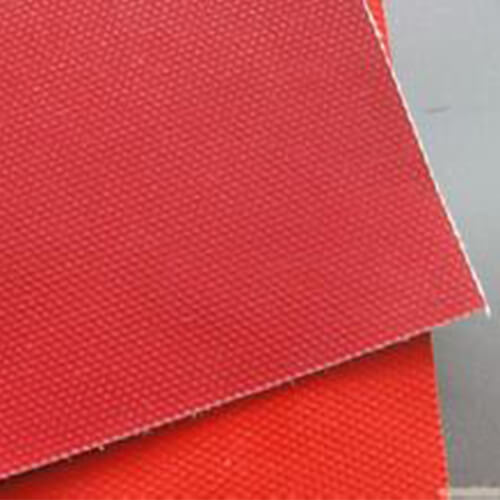
Coated fabricGlass fibre cloth calendered with silicone rubber to form the composite. -
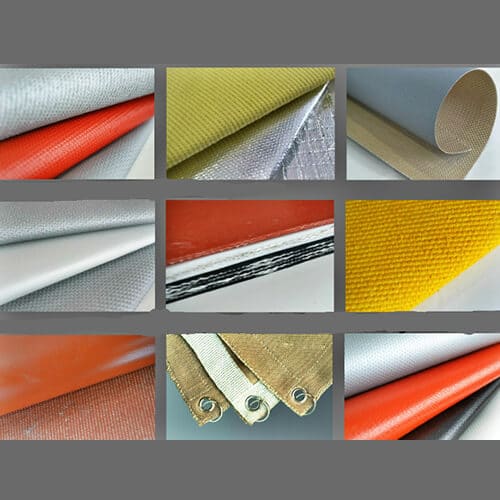
OEM productionCustom colours, coating configurations and sizes to customer specification. -
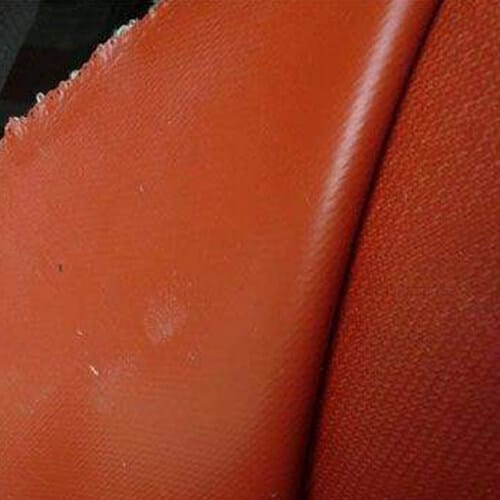
Roll supplySupplied as roll goods for converters and expansion joint fabricators. -
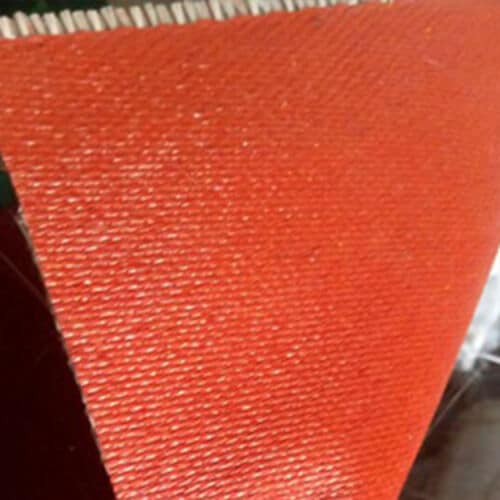
Surface finishThe silicone face carries the chemical and weather resistance. -
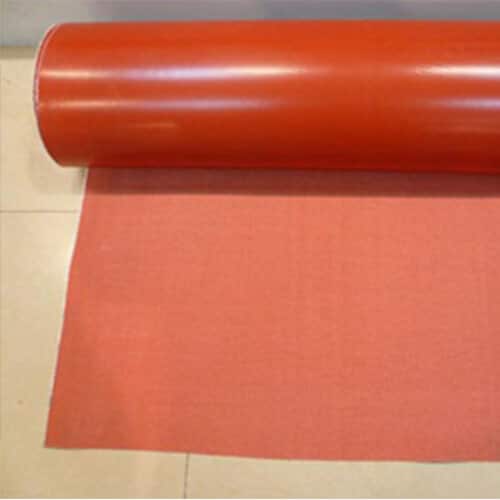
Wholesale volumeBulk supply for distributors and fabricators running continuous production.


Storage and Handling
Unlike our inorganic products, silicone cloth contains a polymer and therefore has genuine storage requirements. Following them keeps the mechanical and insulation properties stable over time.
| Requirement | Specification |
|---|---|
| Storage temperature | 0 to 40 degrees Celsius |
| Relative humidity | Below 75 percent |
| Distance from heat sources | At least 1 metre |
| Avoid contact with | Acids, alkalis and sharp objects that may damage the coating |
| During transport | Prevent compression and folding to maintain product integrity |
The folding instruction is the one most often ignored and the most costly to ignore. A crease pressed into coated fabric while it sits under load in a container can leave a permanent line in the silicone, and on a sealing layer that line becomes a leak path. Roll goods should stay rolled rather than being folded to fit a smaller carton.
How to Specify Silicone Cloth
Five answers let us recommend a coating configuration and formulation rather than sending you the middle of the range.
- What is the material doing? Sealing, flexing, insulating electrically, protecting against corrosion, or a combination. This decides more than the temperature does, and it is the question we ask first.
- Where does it sit in the assembly? Inner sealing layer or outer protective layer. This determines single sided or double sided coating, and getting it wrong produces a predictable failure rather than merely reduced performance.
- What is in the process stream and the surrounding atmosphere? Specifically, is SO2 or sustained water vapour present. If either is, silicone is the wrong material and we would rather establish that before quoting.
- What are the operating temperature and pressure? Both the normal condition and the worst case excursion. The 280 degree for 16 hours figure gives useful headroom, but only if we know what excursion to expect.
- Is fire protection the primary function? If so, say so, because silicone rubber can be formulated in flame retardant grades specifically for that duty and the standard formulation is not the same product.
If you are replacing a material that failed, describe how it failed. Whether the previous fabric hardened, cracked, delaminated, leaked or lost elasticity tells us a great deal about which property was inadequate, and that is far more useful than the specification it was bought against.
Wholesale and OEM Supply
SilicaPro supplies silicone coated fibreglass cloth as wholesale roll goods and under OEM arrangements for expansion joint fabricators, electrical equipment manufacturers, distributors and industrial converters worldwide.
Colour range and coating configuration are both fully customisable, which matters more in this category than it might appear. Expansion joint fabricators frequently need matched single sided and double sided material from the same production batch so that the inner and outer layers of an assembly behave identically. Buying both from one plant makes that straightforward.
Flame retardant formulations are available where fire protection is the primary function rather than a secondary benefit. This is a formulation decision made before production rather than a coating added afterwards, so it needs to be specified at order stage.
Around 70 to 80 percent of our total output is exported, so the documentation, packing and inspection routines that international orders require are routine here rather than exceptional.
Silicone Cloth Questions
The questions fabricators, engineers and procurement teams ask us most often.
Should I order single sided or double sided coating?
It depends entirely on where the fabric sits in the assembly rather than on how much protection you want. Single sided is for outer protective layers, where the coated face takes the weather and the uncoated face bonds to adhesives or adjacent layers. Double sided is for inner sealing layers, where the fabric must be gas tight on both faces.
Specifying the wrong one causes a definite failure rather than merely reduced performance. Single sided used as an inner seal will not hold gas. Double sided used where bonding is needed will not adhere. If your assembly has both an inner and an outer layer, you need both specifications.
Why is the temperature rating so much lower than your other fabrics?
Because it is a different kind of product. The silicone rubber is what limits the temperature, and it is also what provides the sealing, elasticity, pressure retention and electrical insulation that bare glass fabric cannot deliver at any temperature.
If your requirement is heat resistance alone, our high silica cloth works to 1000 degrees continuous and costs less than you might expect. If your requirement involves sealing a gap, absorbing movement or holding pressure, no amount of temperature capability substitutes for what silicone cloth does.
Can it really be used at minus 70 degrees?
Yes, and the low temperature rating is a genuine engineering property rather than a survival claim. Silicone rubber retains flexibility at temperatures where most elastomers become hard and brittle.
That matters for outdoor expansion joints in cold climates, cryogenic equipment and any seal that cycles between very low and normal temperature. A rubber that stiffens in the cold stops absorbing movement, which is the moment an expansion joint stops doing its job.
Why can it not be used with SO2 or water vapour?
Both attack the stability of silicone rubber over time. Sulphur dioxide degrades the polymer, and sustained water vapour exposure affects it similarly. This is a property of silicone rather than a defect in our product, and it applies to silicone coated fabric from any supplier.
The case that most often catches buyers out is flue gas from sulphur bearing fuel, because it usually contains both. If you are specifying a duct liner or expansion joint downstream of a combustion process, check the fuel sulphur content before selecting silicone. Tell us if it is present and we will recommend an alternative.
How long does it last outdoors?
Up to 10 years in outdoor conditions, based on its resistance to ozone, oxygen, UV radiation and general weathering.
That figure assumes normal outdoor exposure rather than an aggressive chemical atmosphere or continuous mechanical abrasion. A membrane on a building and a conveyor belt in a quarry both count as outdoor use, and they will not last the same length of time. Describe the exposure and we will give you a realistic expectation rather than repeating the headline number.
Can it be used for fire blankets and curtains?
Yes, and it is widely used for fire blankets, fire curtains and flame retardant covers in welding protection and building safety systems.
One important point: silicone rubber can be formulated in flame retardant grades specifically for this purpose, and that is a different formulation from the standard product. If fire protection is the primary function rather than a secondary benefit, specify it at order stage so the correct grade is produced.
What working pressure can it hold?
300 kPa working pressure. This is one of the properties that distinguishes a coated composite from a plain woven fabric, since bare glass cloth holds essentially no pressure at all.
Pressure and temperature interact, so tell us both rather than either alone. A material comfortable at 300 kPa at ambient and comfortable at 240 degrees unpressurised may be working harder than you expect when both conditions apply simultaneously.
Can it be cut, punched and fabricated?
Yes. The glass fibre support net underneath the rubber is what allows the material to withstand cutting and punching without tearing or losing structure at the cut edge.
If you are sewing rather than bonding, use a high temperature thread that matches the assembly rather than a synthetic one. We produce a matching thread, and a seam stitched with polyester becomes the temperature limit of the whole assembly.
Why do you specify storage conditions when your other products do not need them?
Because this product contains a polymer and the others do not. High silica cloth is inorganic and essentially indifferent to storage. Silicone rubber is not, so temperature, humidity and physical handling all matter.
The instruction most often ignored is the one about folding. A crease pressed into coated fabric under load can leave a permanent line in the silicone, and on a sealing layer that line becomes a leak path. Keep roll goods rolled rather than folding them to fit a smaller carton.
Can I get a sample before ordering?
Yes. Samples of standard specifications are normally available, and for a material bought on handling and sealing behaviour as much as on rating we would rather you tested it.
Tell us the application and the coating configuration you think you need when you request one. A single sided sample tells you very little if what you actually need is double sided.
What is your minimum order quantity?
Standard colours and coating configurations carry a lower minimum because the material already exists. A custom colour or a flame retardant formulation needs its own production run, which raises both the minimum and the lead time.
Tell us the specification and your rough volume and we will confirm the exact figure with your quotation.
What are your payment terms and shipping options?
Payment is normally by T/T, structured as a deposit with the balance settled before shipment. We confirm the exact split with your quotation.
EXW, FOB, CIF and DAP terms are all available, so you can pick whichever fits how your freight is already arranged. If you have a nominated forwarder we will work with them directly.
Related Products
Materials ordered alongside silicone cloth, and the alternatives worth considering if your temperature requirement sits higher.
Tell Us What the Material Has to Do
Send the function, where it sits in the assembly, the process stream contents, and the operating temperature and pressure. We reply with a coating recommendation, pricing and a lead time we can hold to.
Request a QuotePhone
+8613758326701
Bright Sky New Material Co Ltd.
Room 1101-11, 11/F,Youbang Building. Jiaxing Headquarters Business Garden, Nanhu District, Jiaxing, Zhejiang, 314000 - China
sales@silicapro.com
lucyhhyy@gmail.com
© 2021 SILICAPRO.COM
All Rights Reserved